Top 10 Methods of Performance Appraisal: Traditional and Modern

Performance appraisal is one of the most powerful tools in human resource management. It’s more than a yearly evaluation or a score on a spreadsheet. It’s a process that shapes employee growth, organizational alignment, and overall productivity.
When done well, performance appraisal helps employees understand how their work contributes to broader goals, while giving employers data-driven insight to make fair, informed decisions about promotions, training, and rewards.
This article explores the top methods of performance appraisal, explaining how each works, its advantages and limitations, and when it’s best used.
Purpose of Performance Appraisal
A well-designed appraisal system serves multiple functions:
- Evaluation: Measures how effectively an employee meets job expectations.
- Development: Identifies strengths, weaknesses, and areas for skill-building.
- Motivation: Encourages high performance through recognition and rewards.
- Communication: Creates a channel for dialogue between managers and employees.
- Decision-Making: Supports promotions, transfers, compensation adjustments, and succession planning.
For example, a PwC 2023 “Hopes and Fears” survey covering South Africa, Kenya, Morocco, and Nigeria found that 59% of African employees report satisfaction with their jobs, up from 55% the previous year.
Traditional Methods of Performance Appraisal
Let’s explore the key traditional methods in detail:
1. Graphic Rating Scale Method
The Graphic Rating Scale (GRS) is one of the simplest and most popular appraisal methods. It uses a scale to rate employees on various performance factors such as punctuality, communication, initiative, dependability, and teamwork.
Advantages
- Simple to use and understand.
- Allows quick comparison among employees.
- Useful for large organizations or first-level performance reviews.
Limitations
- Subjective — scores depend on the rater’s bias.
- Doesn’t capture qualitative nuances.
- Focuses more on traits than actual results.
Best Used For:
Entry-level or routine roles where clear, measurable behaviors can be rated consistently.
2. Ranking Method
The Ranking Method involves comparing employees directly and arranging them in order of their overall performance, from the best to the least effective.
How It Works
Managers evaluate each team member and rank them (e.g., 1st, 2nd, 3rd). Rankings can be based on overall performance or specific criteria such as productivity or customer satisfaction.
Advantages
- Easy to implement for small teams.
- Encourages competition and performance awareness.
- Provides a clear sense of top and low performers.
Limitations
- Doesn’t explain why someone ranks higher or lower.
- Creates unhealthy competition or morale issues.
- Difficult to use in large or complex teams.
Best Used For:
Small teams or departments where roles are similar and outputs are measurable (e.g., sales teams).

3. Paired Comparison Method
The Paired Comparison Method is a refinement of the ranking approach. Each employee is compared individually with every other employee on a specific criterion, and the number of times an employee is preferred determines their rank.
How It Works
If there are five employees (A, B, C, D, and E), the manager compares A vs. B, A vs. C, A vs. D, and so on, marking who performs better in each comparison.
Advantages
- Reduces certain biases present in general ranking.
- Provides more detailed comparison between employees.
- Useful when the number of employees is limited.
Limitations
- Becomes complex as team size increases (too many pairings).
- Focuses on relative, not absolute, performance.
- Time-consuming for large departments.
Best Used For:
Small teams or academic settings for evaluating multiple individuals in a controlled group.
4. Checklist Method
The Checklist Method uses a structured list of statements or questions describing employee behaviors and attributes. The manager simply checks whether each statement applies to the employee.
Example:
- Arrives to work on time: ✅
- Communicates clearly with colleagues: ✅
- Meets deadlines consistently: ❌
Each “yes” or “no” response is scored, and the total determines the employee’s performance rating.
Advantages
- Easy to administer; doesn’t require advanced training.
- Standardized approach reduces certain biases.
- Works well for monitoring specific, observable behaviors.
Limitations
- Doesn’t measure performance quality or impact.
- Treats all items as equally important.
- Can become repetitive and mechanical.
Best Used For:
Organizations needing a quick, standardized evaluation such as manufacturing, logistics, or service industries.
5. Critical Incident Method
The Critical Incident Method focuses on recording specific instances (incidents) where an employee displayed exceptional performance; either positive or negative.
How It Works
Supervisors maintain a performance log documenting key events that highlight effective or ineffective behaviors. During appraisal, these incidents are reviewed and discussed.
Example:
- Positive: “Handled a dissatisfied client calmly and retained the contract.”
- Negative: “Missed a project deadline without prior communication.”
Advantages
- Provides rich, behavioral insights.
- Useful for coaching and feedback discussions.
- Reduces recency bias when documented throughout the year.
Limitations
- Requires disciplined recordkeeping by supervisors.
- Focuses on extreme events rather than consistent performance.
- Can appear subjective if not standardized.
Best Used For:
Roles involving client interaction, customer service, or leadership where behaviors significantly influence outcomes.
6. Confidential Report Method
The Confidential Report Method is often used in government, public sector, or military organizations. The immediate supervisor prepares a confidential report evaluating the employee’s conduct, integrity, efficiency, and contribution — which is submitted to higher authorities.
How It Works
Reports are written annually or semi-annually and not shared with the employee directly. The feedback remains internal for promotion or transfer decisions.
Advantages
- Maintains discretion in sensitive environments.
- Encourages honest managerial feedback.
- Simple to implement where hierarchy is strong.
Limitations
- Lacks transparency; employees can’t improve on unknown feedback.
- High risk of personal bias or favoritism.
- Not suitable for modern, open cultures emphasizing two-way communication.
Best Used For:
Highly formal institutions or public organizations that prioritize documentation and senior oversight.
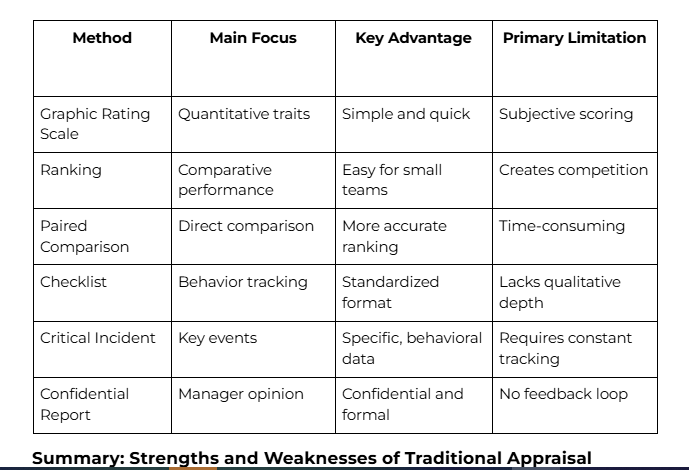
These traditional methods remain relevant where structure, hierarchy, or large workforce evaluation is needed. However, as workplaces become more collaborative and digital platforms like Perkflow. Many organizations have shifted toward modern and continuous performance management systems which we’ll explore further in this article.
Modern and Digital Methods of Performance Appraisal
Let’s explore these modern methods in depth.
7. Management by Objectives (MBO)
This is one of the most effective modern appraisal systems. It was popularized by Peter Drucker and centers on setting mutually agreed-upon goals between managers and employees, then assessing performance based on the achievement of these objectives.
How It Works
- Goal Setting: Manager and employee jointly set SMART goals (Specific, Measurable, Achievable, Relevant, Time-bound).
- Monitoring Progress: Regular check-ins and updates ensure accountability.
- Evaluation: Performance is measured by how well objectives were achieved.
- Feedback and Development: Results are discussed, and new goals are set for the next cycle.
Advantages
- Encourages participation and clarity.
- Aligns individual performance with organizational goals.
- Fosters continuous improvement and accountability.
Limitations
- Requires strong managerial skills to implement properly.
- Time-intensive for large teams.
- Can overlook qualitative traits like teamwork or creativity.
Best Used For:
Knowledge-based roles, leadership positions, or goal-driven departments like sales, product management, and marketing.
8. Behaviorally Anchored Rating Scale (BARS)
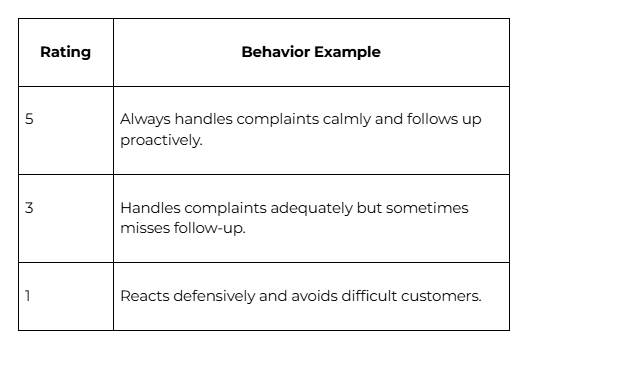
The (BARS) method combines quantitative and qualitative evaluation by linking performance ratings to specific behavioral examples. Instead of vague “good” or “poor” labels, it uses observable behaviors as benchmarks.
How It Works
Each job role is analyzed to define key behaviors that represent varying levels of performance i.e. from poor to excellent.
For example, under the “Customer Service” criterion:
Advantages
- Minimizes ambiguity; focuses on observable actions.
- Improves rater consistency and fairness.
- Encourages actionable feedback for improvement.
Limitations
- Requires significant effort to develop behavioral anchors.
- Time-consuming and role-specific.
- May not adapt easily to rapidly changing job scopes.
Best Used For:
Customer service, HR, healthcare, and roles where behavior directly impacts outcomes.
9. 360-Degree Feedback Appraisal
This method collects performance data from multiple sources — superiors, peers, subordinates, and even customers to provide a complete view of an employee’s performance and interpersonal effectiveness.
How It Works
- Self-Evaluation: The employee assesses their own strengths and weaknesses.
- Manager Review: Supervisors evaluate based on goals and outcomes.
- Peer Review: Colleagues give feedback on teamwork and collaboration.
- Subordinate Feedback: For leaders, direct reports rate communication and leadership style.
- External Feedback: Optional input from clients or partners.
Advantages
- Holistic and balanced feedback.
- Identifies hidden strengths and blind spots.
- Enhances self-awareness and personal development.
Limitations
- Can be influenced by personal bias or office politics.
- Time-consuming to collect and analyze feedback.
- Requires a strong organizational culture of trust.
Best Used For:
Mid- to senior-level employees, leadership development, or team-based organizations where interpersonal dynamics matter.
10. Assessment Center Method
The Assessment Center Method is a multi-dimensional evaluation system that uses simulations, exercises, and role-plays to assess employees’ potential for higher roles.
How It Works
Employees participate in a series of tests such as:
- In-basket exercises: Solving simulated managerial tasks.
- Group discussions: Observing teamwork and leadership.
- Role plays: Testing communication and conflict resolution.
- Case studies or presentations: Measuring analytical and decision-making skills.
Trained assessors observe and rate performance across multiple competencies.
Advantages
- Provides deep insights into leadership and future potential.
- Reduces bias through multiple assessors.
- Excellent for identifying training needs and succession planning.
Limitations
- Costly and resource-intensive.
- Requires professional assessors.
- Not feasible for evaluating large numbers of employees frequently.
Best Used For:
Managerial selection, promotions, or talent development programs.
Conclusion
Performance appraisal is evolving from a compliance-driven task to a strategic enabler of growth. Traditional methods like Rating Scales and Ranking remain valuable for structure and simplicity, but modern techniques like MBO, 360-Degree Feedback, and Assessment Centers foster engagement, learning, and future readiness.
The best systems blend the objectivity of traditional approaches with the insight and flexibility of modern tools. Whether through behavioral assessments, digital dashboards, or collaborative reviews, the ultimate goal remains the same — to help people and organizations perform at their best.
 Written by Ufan-Abasi Francis