What is Employee Turnover? Causes, Costs & How to Calculate It

Imagine leading a team of 100 employees. By the end of the year, 20 have walked out the door. Recruiting ads pile up, managers scramble to fill roles, and remaining employees start asking themselves whether they’ll be next. That’s employee turnover, and it’s silently draining billions from businesses every year. U.S. businesses alone lose an estimated $1 trillion annually due to voluntary turnover. Yet most organizations fail to accurately calculate the true impact or understand why employees leave in the first place.
In the current post-COVID job market, where hybrid work, AI disruption, and generational expectations collide, understanding employee turnover isn’t just an HR function; it’s a survival strategy. This guide breaks down what turnover is, why it matters, how to calculate it, the costs behind it, and, most importantly, how you can reduce it.
What is Employee Turnover?
At its core, employee turnover measures how many employees leave your company during a specific time period, typically tracked monthly or annually. But the number alone doesn’t tell the whole story; it’s the why behind the exits that matters most.
Turnover differs from attrition. Attrition is generally natural or planned, such as staff retirements or roles phased out and not refilled. Turnover, by contrast, is often unplanned, disruptive, and costly. HR leaders use turnover data to understand workforce stability, pinpoint problem areas, and improve long-term planning.
Voluntary vs. Involuntary Turnover
- Voluntary turnover happens when employees choose to leave, often seeking better pay, recognition, or career growth.
- Involuntary turnover is when the company initiates the departure, such as through layoffs or performance terminations.
Functional vs. Dysfunctional Turnover
- Functional turnover isn’t always bad. When underperformers leave, the team can grow stronger.
- Dysfunctional turnover, however, is damaging. Losing top performers or high-potential employees creates long-term risks.
“Employee turnover isn’t just about counting exits—it’s about understanding why people leave and whether those exits help or hurt your business.”
Why Employee Turnover Matters
Turnover is far more expensive than most leaders realize. The Society for Human Resource Management (SHRM) estimates that replacing an employee costs between 6–9 months of their salary. That doesn’t just include recruitment and training it also factors in productivity gaps, cultural disruptions, and even customer dissatisfaction.
Consider this: if a $60,000/year employee leaves, the replacement cost may reach $30,000–$45,000. For highly specialized roles, like software engineers or healthcare professionals, costs can soar to 1.5–2x annual salary. A mid-sized SaaS company, for example, once reported losing over $1 million annually to developer turnover, most of it hidden in lost productivity and delayed projects.
These are tangible costs (job ads, recruiter fees, training) and intangible costs (weakened morale, damaged employer brand). Leaders who underestimate turnover risk erode both profit margins and culture.
“The hidden costs of turnover aren’t just financial—they ripple through culture, morale, and long-term performance.”
How to Calculate Employee Turnover Rate
Tracking turnover rate gives HR teams a vital health metric. The formula is simple:
Turnover Rate = (No of Employees Who Left ÷ Average No of Employees) × 100
Annual Example:
- Employees at start of year: 100
- Employees at the end of the year: 90
- Average employees: (100+90)/2 = 95
- Employees who left: 15
Turnover rate = (15 ÷ 95) × 100 = 15.8%
Monthly Example:
- Employees at start: 50
- Employees at the end: 48
- Average employees: 49
- Employees who left: 4
Turnover rate = (4 ÷ 49) × 100 = 8.1%
While HRIS systems can automate these calculations, manual tracking helps identify trends by department, tenure, or role type. Segmenting voluntary vs. involuntary turnover is especially useful for diagnosing root causes.
“A clear turnover calculation gives HR leaders a dashboard metric: if the number rises, it’s time to investigate and intervene before costs spiral.”
What Causes High Employee Turnover?
Employees rarely leave on a whim. Most departures reflect months of compounding frustrations. The most common causes include:
- Lack of recognition: Feeling invisible is one of the fastest ways to lose talent. Recognition consistently ranks as a top driver of engagement.
- Poor leadership: Micromanagement, weak communication, or toxic managers create “push factors” that drive resignations.
- Compensation gaps: While pay isn’t everything, unfair or stagnant wages accelerate departures.
- Limited growth: When employees see no career path, they start searching elsewhere.
- Burnout: Remote and hybrid work blurred boundaries, leaving many employees overstretched and disengaged.
Emerging Causes in 2025
- AI disruption: Employees fear job loss without retraining or support.
- Generational expectations: Gen Z demands flexibility, growth, and real-time recognition.
- Cultural misalignment: More employees are leaving companies whose values don’t match their own.
Surprisingly, many companies misdiagnose turnover. Leaders often assume pay is the primary issue when, in reality, lack of recognition or career growth is the underlying driver.
“People rarely leave jobs—they leave cultures. Recognition, leadership, and growth opportunities are the real levers of retention.”
Why Does Employee Turnover Cost So Much?
The true cost of employee turnover goes far beyond the obvious expenses of posting a job ad or paying a recruiter’s fee. At the surface level, companies spend money advertising roles, conducting interviews, and onboarding replacements. But beneath the surface lie much larger hidden costs.
The first is the loss of productivity. Employees who leave often take with them years of accumulated knowledge about systems, clients, and processes that cannot be immediately replaced. Studies have shown that it can take anywhere from three to nine months for a new employee to reach the performance level of their predecessor. During this adjustment, team efficiency takes a hit.
Turnover also drains the morale of those who stay. Each departure sends a message to remaining employees, and if the exits become frequent, it fosters a culture of instability. Teams often need to absorb additional work temporarily, which leads to burnout and disengagement. This doesn’t show up on a balance sheet but leads to more resignations; a vicious cycle that multiplies costs.
There is also the customer-facing impact. When client-facing employees leave, relationships that took years to build may vanish overnight. Customers notice turnover, and in industries where trust and continuity are vital, high churn among employees can directly erode loyalty and revenue.
Finally, turnover damages an organization’s reputation over time. A company known for high churn will struggle to attract top talent. Candidates may demand higher salaries to offset perceived risks, or they may avoid applying altogether.
Average Employee Turnover Rates (Industry Benchmarks)
Turnover looks very different depending on industry and region. Recent HR data shows:
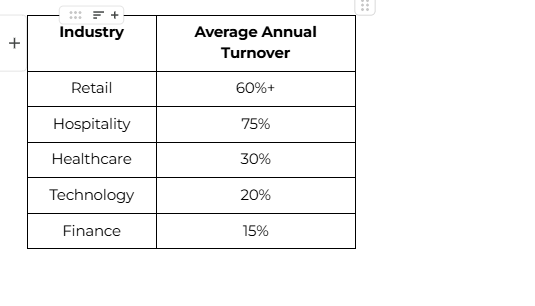
Why the difference? High-churn sectors like retail and hospitality rely heavily on seasonal or entry-level labor, while industries like finance retain talent longer due to high barriers to entry and competitive compensation.
Regional factors also matter. In North America, average turnover is higher due to a fluid labor market. In Europe, stricter labor laws create lower churn, while in emerging economies, turnover can vary widely depending on growth opportunities.
Leaders shouldn’t just compare themselves to industry norms—they should also benchmark against their own historical data to spot internal red flags.
“Benchmarking helps leaders distinguish between what’s typical for their industry and what signals a deeper cultural or engagement issue.”

How to Reduce Employee Turnover
Reducing turnover isn’t about gimmicks—it’s about building a workplace people don’t want to leave. Strategies that work include:
- Recognition & rewards: Employees who feel valued are more likely to stay with a company. Implementing effective recognition and reward programs can significantly boost morale and loyalty. Tools like Perkflow streamline this process, making appreciation seamless and consistent, fostering a positive work environment where employees feel seen and appreciated for their contributions, ultimately reducing turnover.
- Career growth pathways: Providing clear pathways for career advancement, including mentorship programs, ongoing training, and promotion opportunities, is crucial. When employees can envision a future within the organization, they are more invested in their roles.
- Leadership development: The quality of leadership directly impacts employee retention. Great managers cultivate supportive and engaging work cultures, inspiring their teams and fostering loyalty. Conversely, poor management can drive employees away.
- Flexibility: Offering remote-friendly and hybrid work options demonstrates trust in employees and can significantly improve retention. This flexibility allows individuals to achieve a better work-life balance, reducing stress and increasing job satisfaction.
- Well-being: Comprehensive programs that support mental health and promote work-life balance are essential for preventing burnout and maintaining a healthy workforce. When employees feel their well-being is prioritized, they are more engaged and less susceptible to the stressors that lead to attrition.
One company, for example, reduced turnover by 25% in a year simply by implementing a structured recognition program and promoting internal growth opportunities. The key is consistency—recognition should be a daily ritual, not a quarterly afterthought.
“Reducing turnover isn’t about perks in isolation—it’s about building a culture where recognition, growth, and trust intersect.”
FAQs About Employee Turnover
What is a good employee turnover rate?
It varies by industry, but under 15% annually is generally considered healthy. The key is comparing your rate to both industry benchmarks and your company’s historical data. If your turnover is rising year over year, even if it looks “average,” it signals deeper issues worth addressing.
What’s the difference between turnover and attrition?
Turnover happens when employees leave and are replaced; attrition occurs when they leave and positions remain unfilled. For instance, a company might let a role naturally phase out during a restructuring. While attrition can sometimes reduce costs, unchecked turnover typically disrupts continuity and adds expenses.
Can turnover ever be positive?
Yes—functional turnover (e.g., poor performers leaving) can benefit team performance. The challenge is ensuring functional turnover doesn’t outweigh the costs of losing critical knowledge or top performers, which shifts into dysfunctional turnover.
How do small businesses calculate turnover?
Use the same formula but track monthly to quickly detect shifts in small teams. Even one or two departures can drastically change the rate, so breaking it down by quarter or department provides a clearer picture.
What’s the average turnover rate for startups?
Startups often see rates above 20–30% due to volatility, funding changes, and evolving cultures. Founders should expect higher churn but also invest early in culture, recognition, and leadership to stabilize the workforce as they scale.
Conclusion
Employee turnover is inevitable—but it doesn’t have to cripple your business. By understanding what it is, how to measure it, why it happens, and what it costs, leaders can turn turnover into a manageable metric instead of a silent threat.
The best companies don’t just track turnover—they actively build cultures of recognition, growth, and engagement that inspire loyalty. In fact, recognition is one of the simplest and most powerful levers to keep top performers engaged.
Don’t wait until your next resignation to rethink retention. Start building a recognition-rich culture today.
👉 Discover how Perkflow.io helps companies reduce turnover by automating recognition and rewards, creating a workplace where employees feel valued every day.
 Written by Ufan-Abasi Francis