When Do You Actually Need Employee Engagement Software? (2026)

Employee engagement is one of the most widely discussed and often misunderstood areas in modern workplaces. While most leaders agree it matters, many still struggle to determine whether they actually need employee engagement software or if existing tools and manager-led efforts are sufficient.
For some organizations, engagement software feels unnecessary. For others, it becomes essential only after issues like disengagement, turnover, or inconsistent team performance begin to surface. The truth is that engagement software is not a universal solution; it becomes valuable at specific stages, when existing processes can no longer maintain consistency across teams.
This article helps leaders answer a practical question: when does employee engagement need to move from informal efforts to a structured system?
What Is Employee Engagement Software and How Does It Differ from Other Tools?
Employee engagement software is designed to help organizations measure, manage, and act on employee sentiment and participation at scale. At its best, it brings structure to activities that are otherwise manual, inconsistent, or difficult to sustain as teams grow.
However, engagement software is often misunderstood. It is not simply a survey tool, nor is it a replacement for leadership, culture, or human connection. Instead, it provides the infrastructure that allows engagement efforts to be consistent, visible, and actionable across teams.
It also differs from traditional HR systems. HRIS platforms focus on records, payroll, and compliance. Performance tools focus on goals and evaluations. Engagement software sits in a different category entirely: it supports ongoing feedback, recognition, participation, and follow-through, which are the building blocks of engagement.
Understanding this distinction is critical. Organizations that adopt engagement software expecting it to “create culture” are often disappointed. Those who adopt it to support and scale intentional engagement practices tend to see meaningful results.
Top Employee Engagement Software Tools to Consider
Once organizations determine they need employee engagement software, the next challenge is choosing the right platform. The best employee engagement tools do more than collect feedback—they help HR teams turn insights into action, reinforce recognition, and sustain engagement over time.
Below are five employee engagement software platforms HR teams commonly evaluate, based on usability, scope, and ability to support long-term engagement.
1. PerkFlow — Best for Engagement, Alignment, and Execution Visibility
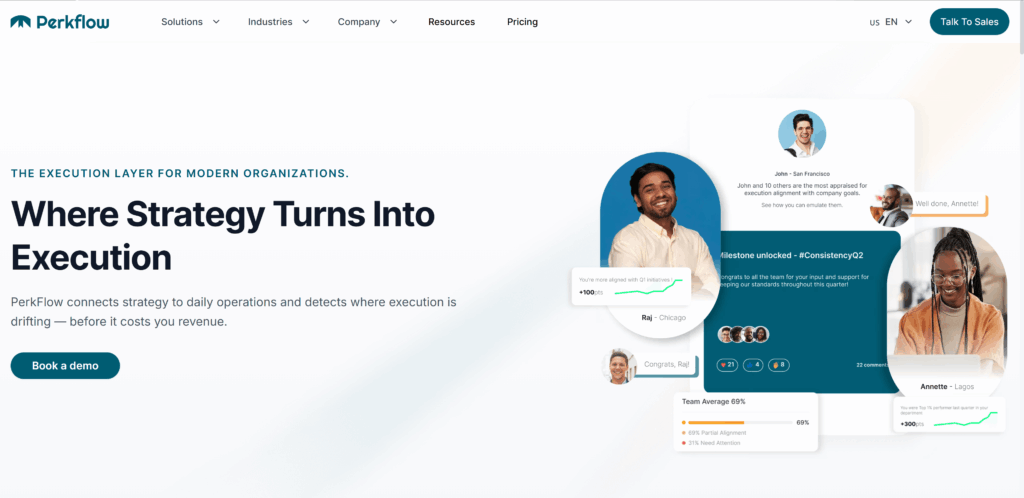
PerkFlow is a structured employee engagement platform designed for HR teams that want engagement efforts to translate into consistent, measurable execution across the organization. Instead of treating engagement as isolated activities, PerkFlow integrates feedback, team signals, and follow-through into a single system.
What sets PerkFlow apart is its focus on closing the execution gap. Calculate your cost here.
Leaders can capture employee input, track how actions are followed through, and maintain visibility into whether engagement initiatives actually translate into improved team alignment and performance.
This makes it especially effective for growing, remote, and distributed teams where consistency, coordination, and visibility often break down without a unified system.
PerkFlow is best suited for organizations that want engagement to be structured, scalable, and directly connected to how work is executed, without relying on fragmented tools or manual processes
2. Culture Amp — Best for Engagement Surveys and Analytics
Culture Amp is widely known for its employee engagement surveys and benchmarking capabilities. It provides strong analytics and reporting, helping HR teams understand trends across engagement, performance, and culture.
However, Culture Amp is primarily insight-focused. While it excels at diagnosing engagement issues, organizations often need additional tools to support recognition, rewards, or execution of engagement initiatives after insights are gathered.
It is best suited for companies that want deep survey analytics and already have strong execution processes in place.
3. Lattice — Best for Engagement Integrated with Performance Management
Lattice combines engagement surveys with performance management features such as goal tracking and reviews. This makes it appealing for organizations looking to link engagement with performance outcomes.
That said, engagement in Lattice is often secondary to performance workflows. Teams focused heavily on recognition, rewards, or continuous engagement may find it less specialized than dedicated engagement platforms.
Lattice works well for organizations prioritizing performance alignment alongside engagement.
4. Officevibe — Best for Lightweight Pulse Feedback
Officevibe focuses on frequent pulse surveys and manager insights. It is easy to implement and helps managers quickly gauge team sentiment through short, recurring feedback loops.
Its simplicity is both a strength and a limitation. While Officevibe surfaces engagement signals effectively, it offers fewer built-in mechanisms for recognition, rewards, or structured follow-through.
It is a good fit for smaller teams or organizations early in their engagement maturity.
5. 15Five — Best for Manager-Employee Check-Ins
15Five centers on continuous manager-employee communication through weekly check-ins and feedback. It supports engagement by improving visibility and dialogue between managers and teams.
However, like several tools in this category, it focuses primarily on communication rather than holistic engagement execution. Organizations may still need complementary tools for recognition and rewards.
15Five is best suited for teams looking to strengthen manager relationships as their primary engagement lever.
Why Do Companies Delay Engagement Software for Too Long?
Many organizations hesitate to adopt engagement software until engagement problems become severe. In early stages, informal engagement methods often feel sufficient. Leaders talk directly to employees, recognition happens organically, and feedback flows naturally. This works until teams grow and communication becomes layered.
Other common reasons for delay include a belief that engagement should emerge “naturally,” cost concerns, or the assumption that managers alone can maintain engagement.
While culture should feel authentic, engagement still requires structure. Feedback gets collected but not acted on, recognition becomes uneven, and insights are discussed but rarely tracked to completion.
Ironically, by the time organizations feel they “need” engagement software, they are often already reacting to problems rather than preventing them.
Signs You’ve Outgrown Manual Engagement Efforts
Organizations rarely adopt employee engagement software suddenly. Instead, recurring friction reveals that manual efforts no longer suffice. Key signs include:
1. Employee feedback stops leading to visible action
Feedback may still be collected through surveys, meetings, or check-ins, but employees no longer see outcomes. Over time, participation declines not because employees lack opinions, but because they lack confidence that sharing them makes a difference.
2. Engagement quality varies widely across teams
Some managers foster strong engagement through consistent communication and recognition, while others unintentionally neglect it. When employee experience depends heavily on who someone reports to, engagement becomes inconsistent and inequitable.
3. Recognition feels sporadic or biased
As organizations grow, recognition often skews toward vocal teams or visible roles. High performers working behind the scenes may feel overlooked, even when their contributions are critical to business outcomes.
4. HR teams rely heavily on spreadsheets and memory
When engagement data is tracked manually, insights become fragmented. Important follow-ups get lost, trends are difficult to identify, and accountability depends on individual diligence rather than systemized processes.
5. Participation drops over time
Low response rates are often treated as an engagement problem, but they are usually a trust problem. Employees disengage when they believe engagement initiatives are performative or lack follow-through.
When multiple signs appear simultaneously, engagement challenges are no longer isolated—they are systemic.
At What Company Stage Do You Need Employee Engagement Software?
There is no universal employee count that determines the need for engagement software. Necessity is driven by organizational complexity.
In early-stage companies, founders often maintain direct relationships with employees. Engagement is high because communication is constant and transparent. However, once teams grow beyond a certain size, leaders can no longer maintain this proximity. Middle management layers emerge, and engagement begins to depend heavily on individual managers.
For growing organizations, especially those between 30 and 100 employees, informal engagement starts to break down. Without structure, companies risk building inconsistent cultures where employee experience depends entirely on who you report to.
Remote and hybrid organizations face this challenge even earlier. Physical distance reduces informal connections, making engagement harder to sustain without intentional systems. Software becomes necessary sooner because visibility, recognition, and feedback cannot rely on in-person interaction.
Larger organizations experience a different version of the same problem. Engagement efforts exist, but they are often siloed, difficult to measure, or disconnected from action. Software becomes necessary not to introduce engagement, but to coordinate it across teams and leadership levels.
What Problems Does Employee Engagement Software Solve?
Engagement software is most effective when it addresses specific, recurring problems. Common challenges include feedback fragmentation, inconsistent recognition, and a lack of accountability.
When feedback lives in surveys, meetings, and email threads, it becomes difficult to track trends or ensure follow-through. Software centralizes this information, making insights actionable. Recognition becomes consistent, timely, and fair, reinforcing positive behaviors across teams.
HR teams can also reduce manual tracking, freeing time for strategic initiatives. Platforms like Perkflow help connect feedback, recognition, and follow-up tasks in one place, reducing operational friction and improving engagement outcomes.
What Employee Engagement Software Will Not Fix on Its Own
While engagement software can amplify engagement practices, it has limits. Organizations often overestimate what software can do. Common areas where it cannot substitute for human effort include:
- Poor leadership behaviors
If managers avoid difficult conversations, dismiss feedback, or fail to support their teams, engagement software will surface these issues faster, but it will not fix them. - A toxic or unsafe workplace culture
Engagement tools cannot compensate for environments where employees fear retaliation, feel excluded, or experience ongoing unfairness. Structural problems must be addressed separately. - Lack of strategic clarity
Confusion about company goals, priorities, or decision-making cannot be resolved by software alone. Engagement tools help communicate direction, but cannot create it. - Low accountability at the leadership level
If leaders do not act on insights or model engagement behaviors, adoption will stall. Engagement software amplifies commitment; it does not create it.
Organizations that succeed with engagement software treat it as a support system, not a cultural shortcut.
How to Decide If Employee Engagement Software Is Worth the Investment
Deciding whether to invest in engagement software requires weighing costs, capacity, and credibility.
Start by evaluating the cost of disengagement, including turnover, lost productivity, and HR time spent manually tracking initiatives. Next, consider sustainability: would current engagement efforts survive if the company doubled in size or added remote teams?
Time savings for HR and managers are another factor, as software frees them to focus on strategic initiatives rather than repetitive administration. Finally, trust is key: employees are more likely to engage when feedback leads to visible outcomes.
When multiple factors indicate that manual methods are insufficient, engagement software becomes less optional and more strategic.
How to Get the Most Value from Employee Engagement Software
Implementation alone does not guarantee success. Value comes from how the software is used.
Organizations that see results set clear expectations. They communicate why engagement software is being introduced, how feedback will be used, and what employees can expect to change as a result.
Manager enablement is equally critical. Managers must understand their role in acting on insights and reinforcing engagement practices. Without this alignment, software adoption stalls.
Most importantly, organizations must act visibly. Even small changes matter if employees can see that their input leads to action. This visibility sustains participation and trust over time.
Engagement software works best when it becomes part of everyday workflows, not a quarterly exercise.
Conclusion: Know the Right Time for Engagement Software
Employee engagement software is not about replacing human interaction; it’s about ensuring consistency in how engagement is supported and sustained across the organization.
It becomes necessary when engagement efforts start to vary across teams, when feedback is not consistently followed through, or when visibility into what is working begins to break down.
In these situations, engagement is no longer just a cultural initiative; it becomes an execution challenge.
PerkFlow helps organizations address this by bringing structure, visibility, and alignment to how engagement is managed, ensuring that feedback and initiatives translate into clear, consistent action across teams.
When engagement is treated as a system rather than isolated efforts, organizations are better positioned to maintain alignment, improve execution, and build a more resilient workplace culture.
 Written by Ufan-Abasi Francis