The Complete Guide to Performance Reviews and Employee Recognition
.png)
Performance reviews have long been a cornerstone of workplace management but not always for the right reasons. For decades, they’ve been known as an annual ritual: employees brace themselves, managers scramble for notes, and the outcome often feels like a report card rather than a roadmap for growth.
That’s changing. Modern organizations are redefining what performance reviews mean, shifting from rigid evaluation to continuous, meaningful dialogue that drives improvement, recognition, and engagement. The secret? Combining structured feedback with genuine appreciation.
When performance reviews evolve from administrative check-ins into opportunities for recognition, they transform company culture. Employees stop dreading reviews and start looking forward to them.
What Is a Performance Review?
At its core, a performance review is a structured evaluation of how well an employee meets job expectations, contributes to team goals, and develops their skills. It’s an opportunity to align individual growth with organizational objectives.
But the definition is evolving. Traditional reviews were backward-looking; a recap of what happened over the past year. Modern performance reviews are forward focused, designed to identify opportunities, build skills, and spark motivation.
Types of performance reviews include:
- Annual reviews: Comprehensive evaluations once a year, often linked to promotions or bonuses.
- Quarterly or mid-year reviews: Frequent check-ins that maintain alignment and momentum.
- 360° feedback: Input gathered from managers, peers, and sometimes clients for a holistic perspective.
- Continuous feedback systems: Ongoing feedback loops supported by digital tools and recognition platforms.
The best-performing organizations combine multiple types supplementing formal reviews with real-time recognition to reinforce great behaviors as they happen.
“A performance review should be a mirror for growth — not a magnifying glass for mistakes.”
The Anatomy of an Effective Performance Review
An effective review doesn’t just happen; it’s carefully designed. The best ones share four essential phases: preparation, structure, delivery, and follow-up.
1. Preparation:
Managers gather data from goals, peer feedback, and KPIs well in advance. This ensures reviews are factual and balanced, not based on memory or bias.
2. Structure:
Every review should have a framework. Discussing goals achieved, challenges faced, skill development, and areas for future focus.
3. Delivery:
How feedback is delivered determines how it’s received. Using positive, specific language helps employees internalize feedback as an opportunity rather than criticism.
4. Follow-Up:
Without a follow-up plan, even great reviews fall flat. Setting SMART goals and pairing them with recognition or learning incentives helps ensure feedback drives action.
“Feedback without follow-up fades fast and recognition gives it lasting momentum.”
Psychology of Recognition in Performance Management
Recognition isn’t just a nice gesture; it’s a psychological multiplier for motivation.
When employees receive genuine appreciation, their brains release dopamine — a neurotransmitter associated with pleasure and reward. Over time, this reinforces positive behavior, driving stronger engagement and effort.
Research consistently supports this link:
- Employees who feel recognized are 4.6x more likely to be engaged at work.
- 70% of employees say motivation improves after being appreciated.
- Companies with strong recognition programs have 31% lower turnover.
Recognition transforms feedback into fuel. When performance reviews highlight strengths and celebrate them, employees are more likely to act on developmental feedback — because they already feel valued.
Turn every performance review into a moment of motivation. Discover how Perkflow automates recognition after every milestone and feedback exchange.

“Recognition turns feedback from a judgment into a journey, a shared pursuit of excellence.”
Common Pitfalls in Performance Reviews (and How Recognition Fixes Them)
Even the most well-intentioned reviews can fall short. Here’s why and how recognition can turn things around:
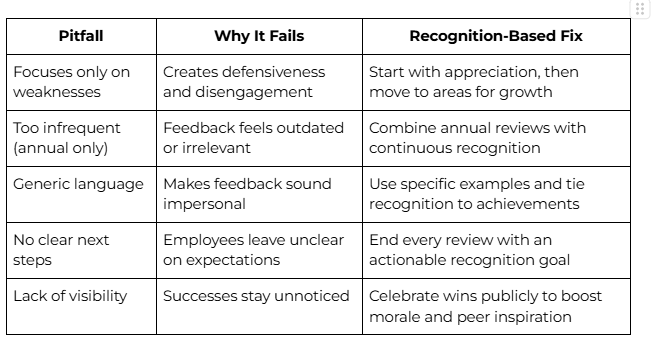
“Recognition bridges the gap between evaluation and encouragement; the point where performance truly grows.”
Integrating Recognition Into the Review Process
Recognition isn’t an afterthought, it’s the connective tissue between performance management and motivation.
Here’s how HR teams can integrate recognition at every review stage:
Step 1: Align criteria with recognition categories.
If teamwork, innovation, or leadership are part of your evaluation, build recognition badges or rewards around those traits.
Step 2: Automate recognition moments.
When an employee exceeds KPIs or earns top feedback scores, trigger an automatic reward through your recognition platform.
Step 3: Use peer recognition alongside managerial feedback.
Encouraging peers to acknowledge one another strengthens review credibility and culture.
Step 4: Include recognition metrics in review discussions.
Recognition data (how often someone is acknowledged, for what behaviors, by whom) offers valuable insight into cultural impact and leadership potential.
Step 5: Celebrate progress, not just perfection.
Use recognition to reward consistent improvement not just top performance but to reinforce a growth mindset.
“Integrating recognition into reviews doesn’t just boost morale, it creates a feedback culture that thrives on celebration.”
Note: Perkflow automatically ties recognition events to performance outcomes; turning data into inspiration.
Tools and Technology That Bridge Reviews and Recognition
In the past, performance reviews lived in spreadsheets and static forms. Recognition was manual — a thank-you email here, a gift card there.
Today, HR technology bridges those silos. Modern performance platforms help companies:
- Track performance goals and progress in real time.
- Enable continuous feedback loops between peers and managers.
- Automate recognition and rewards post-review.
- Generate engagement analytics to measure impact.
Perkflow’s approach:
Perkflow integrates seamlessly with HR systems, Slack, Teams, and communication tools, allowing organizations to automatically recognize employees the moment performance data shows excellence.
Instead of HR spending hours managing reward logistics, recognition happens instantly — global, personalized, and data-driven.
“Technology doesn’t replace empathy — it scales it.”
Best Practices for HR Managers and Reviewers
Reviews should spark meaningful dialogue, encourage growth, and reinforce a culture of recognition that keeps talent engaged long after the meeting ends.
1. Schedule regular, predictable check-ins
Consistency builds trust. Rather than waiting for annual reviews, host shorter, quarterly conversations focused on progress and goals. Let employees know ahead of time what topics will be covered so they can prepare. This transparency removes anxiety and turns reviews into collaborative planning sessions instead of surprise audits.
2. Train managers in feedback delivery
Even the best feedback fails if it’s delivered poorly. Train managers to frame feedback constructively — start with acknowledgment, discuss opportunities, then end with support. Role-play difficult scenarios during manager training so leaders know how to guide the conversation with empathy and objectivity.
3. Balance recognition and critique
Adopt the 3:1 principle — for every piece of developmental feedback, offer three acknowledgments of strengths or wins. This balance helps employees internalize feedback as support, not criticism. For instance, praise a team member’s leadership before discussing communication gaps; they’ll be more open and motivated to improve.
4. Make recognition public when appropriate
Public recognition amplifies motivation. Celebrate accomplishments during all-hands meetings, newsletters, or company Slack channels. This not only validates the individual but also reinforces positive behaviors across teams. However, tailor recognition to each employee — not everyone enjoys the spotlight.
5. Close the feedback loop
A great review doesn’t end in the room. Translate feedback into tangible goals and follow up within 30 to 60 days. Recognize milestones along the way — even small improvements deserve acknowledgment. Perkflow’s automated workflows can make this easy by triggering rewards when progress is logged.
6. Measure and refine your process
Use data to learn what works. Track engagement scores, peer feedback volume, and recognition activity after review cycles. The most effective HR teams treat reviews as evolving systems — continuously refined through analytics and employee input.
“A truly effective review doesn’t end with feedback, it ends with renewed motivation.”
The Future of Performance Reviews
The next decade will redefine how organizations manage performance. The old, static model is fading fast replaced by agile systems that blend data, empathy, and automation.
Key trends to watch:
- Continuous performance tracking: Ongoing micro-feedback loops instead of annual summaries.
- AI-assisted phrasing: Tools that help managers frame feedback more constructively.
- Recognition analytics: Predictive insights on who’s likely to disengage based on recognition frequency.
- Integration with wellbeing programs: Recognition linked with holistic employee wellness.
- Equity and transparency: Review systems that minimize bias and promote fairness.
Performance reviews will become less about evaluation and more about empowerment. Recognition will be the emotional engine driving that evolution.
“The future of performance reviews isn’t annual. It’s alive fueled by recognition, data, and humanity.”
Conclusion: From Review to Recognition
Performance reviews are no longer just management obligations, they’re opportunities for meaningful connection. When HR leaders link structured feedback with authentic recognition, they create a culture of trust, growth, and belonging. Employees feel seen, valued, and motivated to exceed expectations; not out of fear, but pride.
That’s where platforms like Perkflow come in. By turning every review into a moment of appreciation, Perkflow helps global teams close the feedback loop instantly, transforming performance management from paperwork into purpose.
Transform your next review cycle. Discover how Perkflow automates recognition and rewards to make performance management truly human.
 Écrit par Ufan-Abasi Francis