Internal Analysis vs SWOT Analysis: Turn Company Data Into Real Strengths and Weaknesses(2026)

How do you prove that certain qualities actually create value?
Internal analysis investigates how the company works, what it owns, what it can do, and where performance breaks down. SWOT then summarises the most strategically relevant findings alongside external opportunities and threats.
They serve different purposes. Understanding that sequence helps companies move beyond subjective labels and identify strengths and weaknesses that can support real decisions.
So, how do you turn company data into evidence you can trust? Read on to find out.
What Does Internal Analysis Mean in Strategic Management?
Internal analysis is the structured examination of an organisation’s resources, capabilities, processes, financial position, workforce, systems and performance. Its purpose is to establish what the organisation can realistically achieve with its current operating model.
The analysis examines tangible resources such as cash, equipment, facilities and technology. It also considers less visible sources of performance, including institutional knowledge, leadership routines, supplier relationships, decision speed, data quality and the ability to coordinate work across departments.
A complete internal analysis focuses on :
- What are our true competitive advantages?
- Where are our operational and structural vulnerabilities?
- Which activities drive the most value (and which waste profit)?
- Do we have the financial health to execute our strategy?
- Are our internal capabilities aligned with our strategic goals?
Internal analysis therefore deals with organisational reality. It explains the causes behind results instead of repeating the results shown on a dashboard.
What Does a SWOT Analysis Examine?
SWOT analysis organises strategic information into four categories:
- Strengths: Internal factors that support the objective.
- Weaknesses: Internal factors that make the objective harder to achieve.
- Opportunities: External conditions the organisation may be able to exploit.
- Threats: External conditions that could damage performance or reduce strategic options.
SWOT is a planning tool that helps align an organisation’s goals, programmes and capabilities with the conditions of its operating environment.
Linking the analysis to a clearly defined objective is therefore essential, as strengths and weaknesses only become strategically meaningful when assessed in relation to what the organisation is trying to achieve.
For example, allowing branch managers to approve customer refunds may help a growing company respond quickly to local issues. However, if the company later introduces a single company-wide control process, that same freedom may create inconsistent decisions. The operating structure has not changed, but its strategic value has changed because the objective is different.
SWOT gives a concise view of an organisation’s strategic position. It brings internal strengths and weaknesses together with external market, regulatory, technological and competitive conditions. Its four-quadrant structure helps teams identify and discuss priorities without reviewing a full internal analysis each time.
What happens when this simplicity begins to create problems? Read on to see where SWOT can fall short and how a deeper internal analysis strengthens the findings behind it.
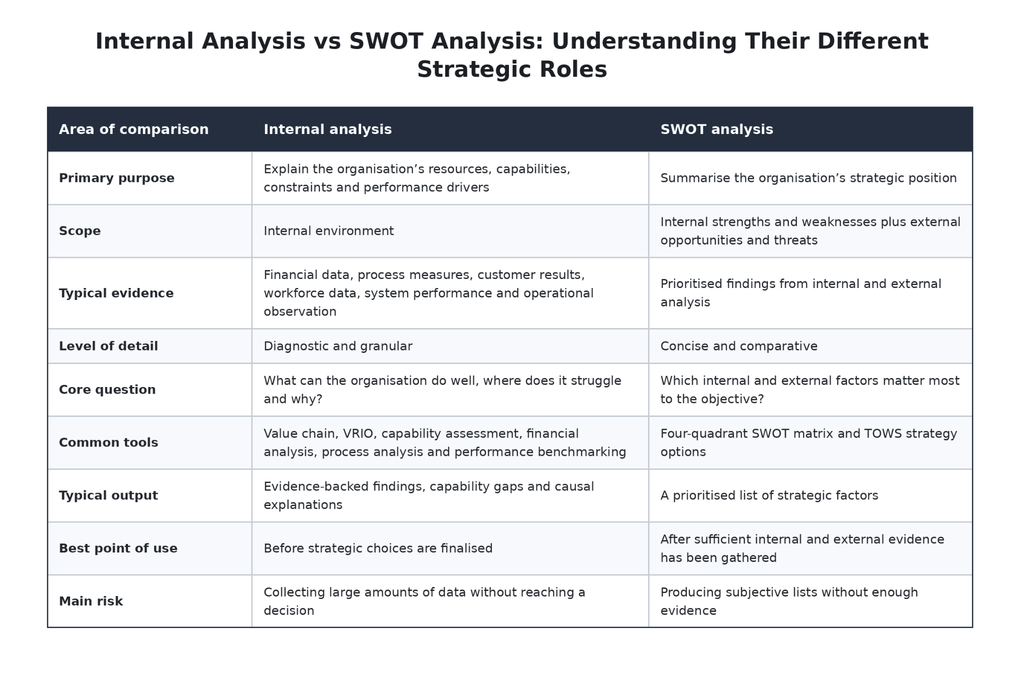
The practical relationship can be simplified into these two major points:
- Internal analysis supplies evidence for the strengths and weaknesses in SWOT.
- External analysis supplies the opportunities and threats.
SWOT then helps the strategy team examine the relationships between them.
Team-level comparison may show that strong customer-service results come from clear role ownership, experienced staff coaching newer employees, and a process the whole team follows consistently. Calling this simply a “strong workforce” would be too broad. “A well-trained team with a repeatable coaching and service process” would be a more accurate strength.
The second description explains what is actually creating the result and gives the company something it can protect, measure, and replicate.
How SWOT Misclassifies Internal Strengths and Weaknesses
A SWOT workshop can produce the wrong picture of a company when positive results are accepted too quickly as strengths. Take the statement, “We have a strong brand.” The description sounds credible, yet the company still needs to establish:
- What is our Customer Lifetime Value (CLV) compared to Customer Acquisition Cost (CAC)
- Are we relying on single-buyer loyalty or a repeatable acquisition loop?
- What is our true runway if market conditions shift?
- Where are the hidden cost leaks?
- What is our actual capacity utilization?
- How long is our cycle time compared to the industry standard?
- What is our voluntary turnover rate in business-critical roles?
One strength can mean a lot of questions to track and understand; the same for a weakness. But two major problems reduce the SWOT findings;
1. The “Laundry List” Problem (Lack of Prioritization)
A standard SWOT matrix puts “Our website has a high bounce rate” (a minor tactical issue) right next to “Our core patents are expiring in 12 months” (a catastrophic corporate threat).
The Danger: Because it is just a bulleted list, leadership teams often pick the easiest things to fix rather than the most critical ones. It doesn’t tell you how much a strength helps or how badly a weakness hurts.
2. Extreme Subjectivity and Confirmation Bias
SWOT relies entirely on the opinions of the people in the room, not objective data. Without deep verification, it quickly becomes an exercise in self-delusion.
The Danger: It results in an “inside-out” view of the world. What an organization thinks is a strength might actually be considered mediocre or outdated by its customers and competitors.
Internal Analysis Across Six Areas of Organisational Performance
The six connected areas that a complete internal analysis must cover include:
1. Financial analysis should reveal where value is created and absorbed
Review revenue quality, margins, cash conversion, cost structure, capital commitments, and investment returns. Segment the results by product, market, customer group, or location where possible.
Questions worth asking include:
- Which products generate contribution after service and delivery costs?
- Where has cost grown faster than output?
- Which activities consume cash before producing returns?
- How much financial flexibility exists under a weaker demand scenario?
- Which reported efficiencies have transferred cost to another department?
A company-wide margin can conceal an unprofitable customer segment supported by profitable accounts. Internal analysis should expose that cross-subsidy before “strong financial performance” enters SWOT.
2. Operational analysis should trace value across the complete workflow
Value chain analysis breaks the organisation into strategically relevant activities so teams can see where value is created, where costs increase and which activities support better margins or customer outcomes.
Follow the work from demand through to delivery and examine what happens at each stage. Measure throughput, waiting time, error rates, rework, capacity, cost and service outcomes. Pay particular attention to handoffs between teams, because delays often occur between functions and may not appear clearly on individual departmental dashboards.
The same principle applies when measuring operational efficiency across teams. Learn more here.
3. Human Capital and Organizational Culture
An organization is only as good as the people executing the strategy and the environment they work in.
- Talent and skills: Evaluating skill gaps, leadership pipelines, and technical expertise.
- Culture and alignment: Assessing employee turnover, morale, internal communication, and whether the company’s stated values match daily employee behavior.
- The Connection: Human capital dictates the speed and quality at which capabilities are executed.
Practical next step: If your analysis reveals inconsistent performance across teams or locations, PerkFlow’s execution intelligence platform can connect strategy with role-level execution signals and show where capability or alignment is breaking down.
4. Workforce analysis should examine capability at the point of execution
Headcount and qualifications provide an incomplete view of workforce strength. Assess skill depth, role coverage, productivity, succession risk, decision authority, and the distribution of critical knowledge.
Useful evidence includes:
- Capacity required versus capacity available
- Proficiency in capabilities linked to the strategy
- Time needed for new hires to reach expected performance
- Dependence on individual employees
- Internal mobility into critical roles
- Managerial span and workload
- Performance variation among comparable teams
- Turnover within strategically important positions
A capability becomes a genuine strength when the organisation can deploy it predictably. If one branch performs well and nine others cannot reproduce the method, the company has a local success rather than an organisational capability.
Organisational alignment during growth becomes especially important here. Learn more here
5. Technology and data analysis should connect systems to business outcomes
Examine system reliability, adoption, integration, security, technical debt, data accessibility and the speed at which technology supports business changes.
Ask:
- Which critical processes still depend on manual reconciliation?
- Where do teams maintain separate versions of the same information?
- How long does it take to implement a pricing, product, or policy change?
- Which systems create recurring delays or control failures?
- Can the organisation trace strategic KPIs to reliable source data?
- Does proprietary technology improve cost, speed, quality, or customer value?
6. Product/Service Portfolio and Market Position
This looks directly at what the organization sells and how those offerings perform in the real world.
- Life cycle analysis: Determining if current products are growing, maturing, or becoming obsolete.
- Revenue concentration: Identifying if the business relies too heavily on a single product or customer segment.
- The Connection: This connects the internal engine of the company to the external revenue it generates.
Tracking Internal Findings with Quantifiable Evidence
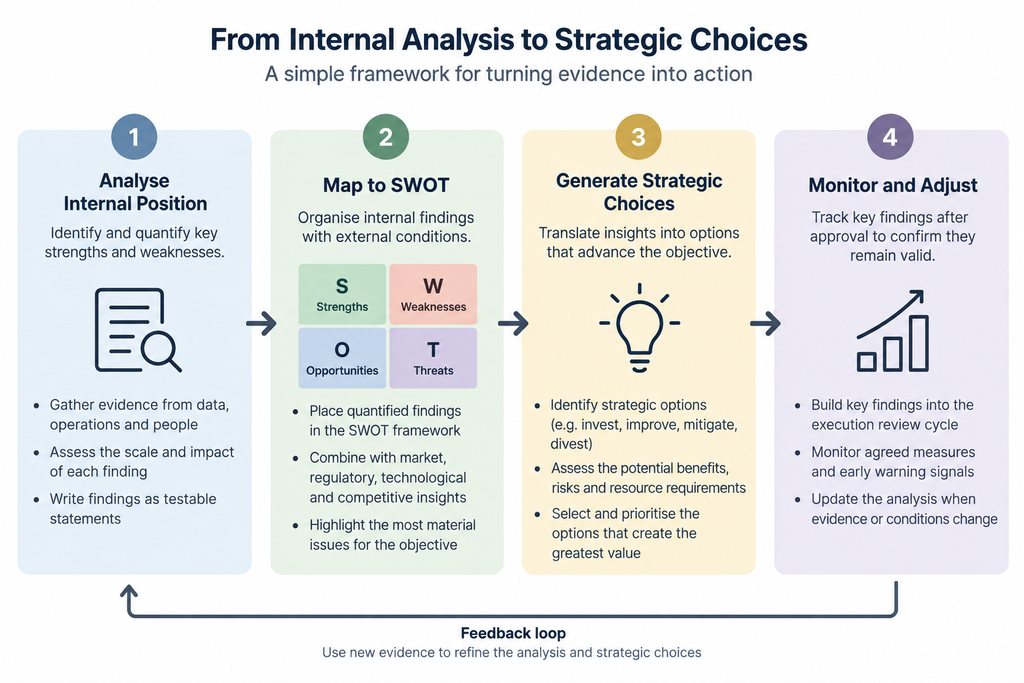
Use these four steps to quantify your evidence.
Finding + evidence + benchmark + implication.
For example, customer response time may exceed its target overall but fall sharply during peak periods. This shows both the strength and its limit.
The same approach applies to weaknesses. A statement such as “outdated technology” becomes more useful when it shows the time, cost, or errors caused by the system.
These findings should also be reviewed after the strategy is approved. Quarterly checks can confirm whether the evidence still supports the original assessment and whether changing conditions have strengthened or weakened the finding.
Common Internal Analysis Mistakes to Correct
- Assumptions
- Outdated data
- Weak benchmarking
- Overgeneralisation
- Misdiagnosis
- Capacity gaps
- Poor prioritisation
- Missing accountability
- Inconsistent measurement
- No follow-up
Conclusion: Strong Strategy Starts with Strong Evidence
A SWOT is only as reliable as the evidence behind its strengths and weaknesses. When internal findings are measurable, comparable, and regularly reviewed, they become a stronger basis for deciding what to protect, improve, invest in, or change.
The value comes from turning company data into choices that remain valid as the organisation evolves.
See how PerkFlow keeps strategic priorities connected to measurable execution signals. Book a PerkFlow demo today.
Frequently Asked Questions
What is internal analysis in SWOT?
Internal analysis examines the organisation’s resources, capabilities, processes, and performance to identify evidence-based strengths and weaknesses.
What is the difference between internal analysis and SWOT analysis?
Internal analysis investigates the organisation in depth, while SWOT combines its key internal findings with external opportunities and threats.
What are examples of internal factors in SWOT?
Internal factors include financial capacity, workforce skills, technology, processes, intellectual property, leadership capability and operational performance.
How do you conduct an internal analysis?
Start with a clear strategic objective, examine relevant company data, compare performance against suitable benchmarks, and identify the capabilities or constraints that materially affect that objective.
What tools are used for internal analysis?
Common tools include VRIO, value chain analysis, benchmarking, financial analysis, capability assessments, and process analysis.
How often should internal analysis be updated?
Internal findings should be reviewed whenever significant changes affect performance, resources, or strategic assumptions, with key measures monitored throughout execution.
Should internal analysis be completed before SWOT?
Yes, because strengths and weaknesses are more reliable when they come from tested internal evidence rather than assumptions made during a SWOT session.
 Written by Ufan-Abasi Francis