3 Problems With Performance Reviews (And What to Do Instead)
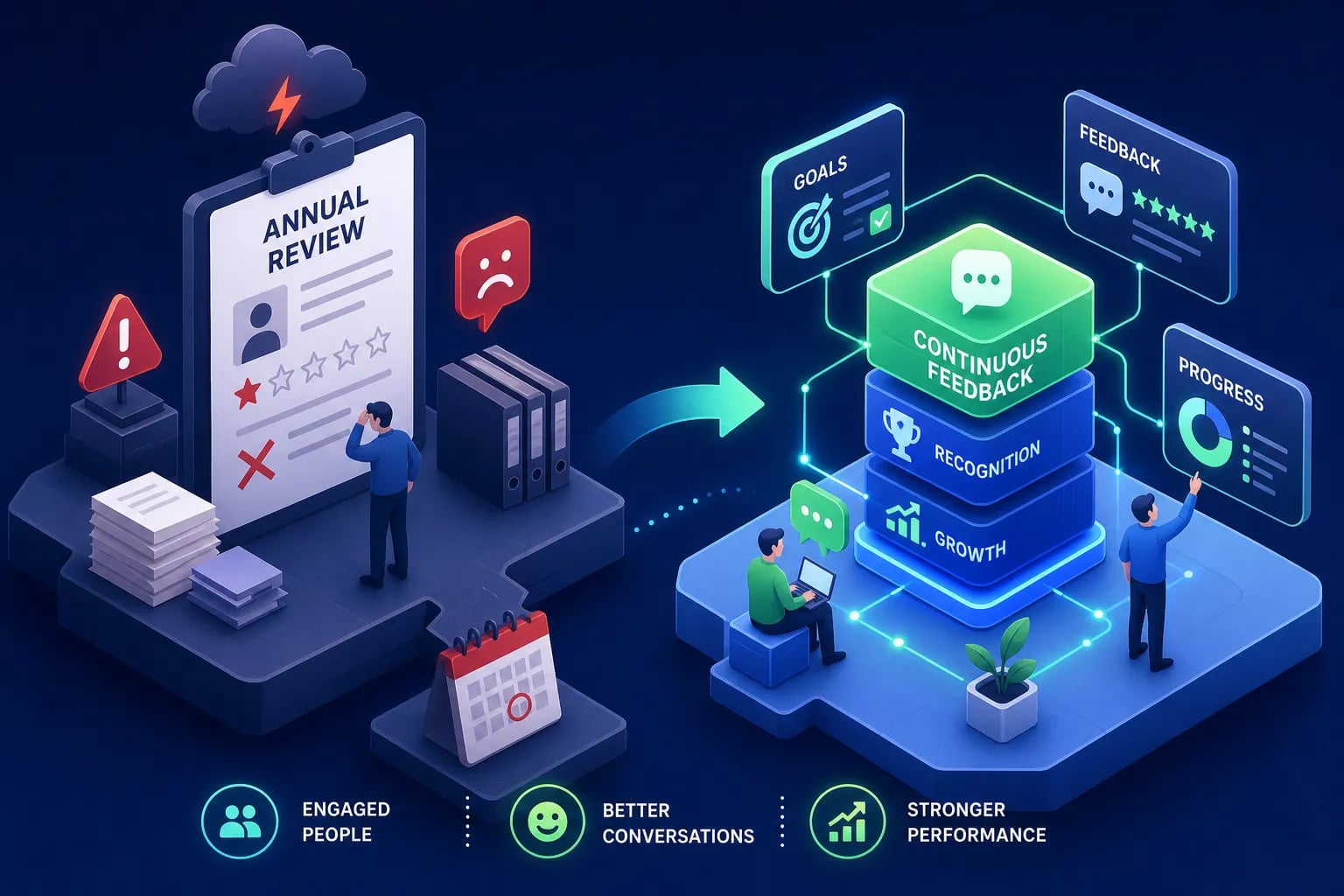
Why Performance Reviews Keep Failing (And What to Do Instead)
Performance reviews are dreaded on both sides of the table. Managers struggle to write them; employees brace for receiving them. And somehow, after the 45-minute meeting wraps up, both parties often leave feeling like little will change. That shared frustration is not a coincidence, but a structural problem baked into the way most organizations collect, or fail to collect, performance data throughout the year.
Performance is continuous. The review is a snapshot. That mismatch is the core of the problem. A single conversation, built on several months of fragmented memory and a blank rating form, cannot reliably represent a year’s worth of work. Industry surveys consistently find that around 95% of managers are dissatisfied with the annual review process, and roughly 90% of HR leaders say it doesn’t produce accurate information. Those numbers are not a referendum on managers. They are an indictment of the system design.
This article walks through what consistently breaks in the traditional process, what better performance management architecture looks like, and how to run performance reviews that are grounded in real evidence rather than impression and recall.
Why the Traditional Annual Performance Review Model Keeps Falling Short
The once-a-year timing problem
Annual performance appraisals create a false sense of completeness. They suggest that one conversation, held once a year, can fairly account for twelve months of complex work across shifting priorities, team dynamics, and business conditions. In practice, important moments get lost, forgotten, or smoothed over. A problem that surfaces in Q2 likely won’t be addressed until Q1 of the following year, by which point the impact has already compounded. That is not a manager failure. It is a design flaw.
The timing problem also creates a perverse incentive structure. When employees know that one conversation determines how they’re perceived for the year, there is pressure to concentrate effort and visibility in the final stretch before review season. The actual consistency of execution throughout the year becomes secondary to how things look at the end. That is the opposite of what high-performing operations need.
What gets rated versus what actually happened
Most employee review forms ask managers to rate behaviors they may have directly observed only a handful of times. A manager overseeing a distributed team, or one with a broad span of control, isn’t watching execution at the ground level every day. The review reflects the manager’s incomplete visibility, not the employee’s full contribution. Uneven observation across a team means two employees doing similar work get rated on fundamentally different evidence bases. In multi-department or multi-location environments, where the operational reality of daily execution is several layers removed from the person writing the review, the performance assessment ends up being a reconstruction rather than a record.
How Recency Bias Silently Distorts Performance Reviews
Why the last 90 days carry too much weight
When managers sit down in December to write a performance review, they naturally recall what happened in October and November more vividly than what happened in March. A strong Q4 can mask a rough mid-year. A stumble right before review season can overshadow months of solid execution. This is not a character flaw in managers. It is how human memory works, and review cycles that rely on recall rather than documentation are systematically vulnerable to it.
The practical consequence is that the review doesn’t reflect performance across the full cycle, it reflects performance salience, which is a different thing entirely. Employees who happen to close a big win or make a visible mistake near review time are disproportionately affected in either direction, regardless of what the other nine months looked like.
The fairness cost of inconsistent observation
Recency bias is also a fairness problem. When managers work from memory rather than documented evidence, bias fills the gaps. Organizational psychology research, including decades of findings from institutions studying implicit bias in high-stakes professional decisions, consistently shows that systemic controls, such as continuous documentation, calibration sessions, and structured rubrics, reduce bias more reliably than awareness training alone. Without those guardrails, the performance review process is only as accurate and fair as the manager’s recall and perspective, and that is a low bar for any organization that cares about equitable outcomes.
The solution is not to ask managers to try harder to remember things fairly. The solution is to stop relying on memory as the primary data source, and to build structural alternatives that don’t require heroic recall in the first place.
What Continuous Execution Signals Change About the Whole Process
The difference between checking in and capturing signals
Execution signals are not the same as informal check-ins. A weekly one-on-one is valuable, but it is unstructured and its insights evaporate unless someone documents them. Systematic signal capture is different: it creates a timestamped, evidence-based record of role-specific performance indicators, KPI variance over time, behavioral consistency data, and output quality patterns tracked across weeks and months. That record is the missing layer between the daily work and the annual conversation.
When this layer exists, the performance review transforms from a memory exercise into an evidence-based debrief. Both the manager and the employee arrive at the conversation anchored to the same documented reality. The review shifts from feeling like a verdict to functioning as a genuine planning tool, and that shift changes what both parties are willing to say in the room.
Where tools like PerkFlow come in
This is exactly the gap that execution intelligence platforms are built to close. PerkFlow, for example, is designed to sit on top of existing systems, tools like SAP, Slack, and Jira, without replacing them, capturing execution signals continuously across roles, departments, and locations. The platform is built to surface where alignment may be slipping, which KPIs are trending off course, and what the potential business impact of those gaps could look like.
By the time a performance review meeting arrives, managers using PerkFlow can have weeks of documented evidence to draw on rather than starting with a blank form and a mental highlight reel. That shifts the entire conversation. Instead of reconstructing the past from memory, both parties can review a structured record of what happened and focus the meeting on what comes next. Moving from retrospective judgment to forward-looking 360 feedback and planning is what makes the process worth doing.
How to Build a Review Process Grounded in Real Evidence
The five-step process that changes what performance reviews feel like
The quality of a performance review conversation is almost entirely determined by the quality of the preparation that preceded it. Most managers underinvest in preparation and then wonder why the meeting feels vague. Here is the process that changes that.
- Define clear goals and measurable success criteria at the start of the cycle, not retrospectively when the review is due.
- Collect evidence continuously through documentation, notes, execution data, and role-specific performance signals throughout the period.
- Request a self-assessment from the employee before writing the reviewso both sides are anchored in the same facts before the conversation begins.
- Hold a two-way review conversation focused on specific examples and future development, not a one-sided rating delivery.
- Agree on concrete next steps with timelines, clear ownership, and a scheduled follow-up check-in date.
What good performance feedback actually sounds like
Vague impressions are not feedback. “Great team player” tells an employee nothing actionable. “You resolved three escalations independently in Q2, which reduced load on the senior team by about 20%” tells them exactly what high performance looks like in their role. The goal is to make the review feel like a factual debrief, not a personality judgment.
For a high performer: “You consistently meet deadlines, communicate proactively with stakeholders, and take ownership of issues before they escalate. That pattern had a clear positive impact on team delivery this cycle.” For an employee needing improvement: “Your output has been inconsistent this cycle, particularly around deadlines and prioritization. Focusing on planning cadence and more frequent check-ins will help improve reliability next quarter.” For a development conversation: “A strong next goal is to build delegation skills so you can manage more complex workloads without requiring close oversight.” Every example above is specific, behavior-based, and pointed at what comes next, that combination is what separates useful performance feedback from noise.
Metrics That Tell the Real Story for Individuals and Managers
What to measure for individual contributors
Individual contributors should be evaluated across four to six dimensions: quality of output, delivery timeliness, productivity or throughput, outcome impact, peer and stakeholder feedback, and learning or skill development. Activity counts, like meetings attended or emails sent, are not performance measures. They are inputs, and confusing inputs for outcomes is one of the most common ways performance assessment loses credibility with the people being assessed.
Every metric should tie back to a team or organizational outcome so the measure feels meaningful rather than bureaucratic. When employees see the connection between their daily execution and a result the business cares about, the performance management process earns their engagement rather than their compliance.
How manager performance assessment should look different
Manager KPIs should not mirror individual contributor KPIs. Managers create leverage through others, so their performance assessment should reflect team goal attainment, delivery predictability, team quality metrics, retention, development of direct reports, and engagement. A manager who hits personal productivity numbers while their team churns or underperforms is not a high performer by any meaningful definition. That distinction matters, and most review templates don’t make it clearly enough.
OKR-linked measures work well for managers when the goal chain cascades correctly from individual to team to organizational strategy, and the manager’s performance assessment reflects whether that chain held together. That is the architecture that makes performance management feel like a business system rather than an annual formality.
Making the Feedback Stick After the Meeting Ends
Why the review meeting is only half the job
The most common follow-up failure looks like this: managers hold the review, both parties feel good about the conversation, and then nothing changes because there is no structured follow-up. Commitments made in a review meeting need a home, a written recap, a scheduled check-in, and a clear owner for each action item. Without that structure, the review is an event rather than a process, and events don’t change behavior.
Send a written recap within 24 hours of the meeting. Confirm mutual understanding of the key takeaways. Schedule the follow-up check-in before leaving the room. These are not complex steps, but many organizations skip them and then wonder why performance conversations don’t translate into performance improvement.
Building the 90-day plan that replaces the rating sheet
The most effective output of a performance review isn’t a rating. It’s a forward-looking 90-day development plan that both parties co-own. The plan should include two to three specific goals, the resources or support the employee needs to achieve them, a check-in date, and a clear description of how progress will be measured. That structure converts a performance management conversation into actual behavior change.
It also makes the next review cycle dramatically easier. When both parties arrive with a documented 90-day plan from the previous cycle, the review becomes a progress debrief rather than a fresh reconstruction of the past. The quality of each cycle builds on the last, and over time, performance management becomes something the organization genuinely does rather than something it performs once a year.
Performance Reviews Work When the Data Does
Performance reviews don’t fail because managers are bad at giving feedback. They fail because the underlying data is thin, retrospective, and inconsistent. The fix isn’t to run more reviews or redesign the rating form. It’s to build a continuous evidence layer throughout the year so the review itself becomes a confirmation of what both parties already know, not a surprise.
When reviews are grounded in real execution data, they function as a strategic planning tool rather than an annual judgment. That shift, from performance appraisal as verdict to employee review as forward-looking strategy, is what makes the whole process worth investing in. If you’re ready to see what that looks like for your organization, reach out to the PerkFlow team to learn how continuous execution signals can support your next review cycle.
 Written by Steve Mbenoun