7 Best Employee Incentive Software for Modern Workplaces

Employee incentive software helps organizations design, manage, and scale incentive programs that motivate performance, improve engagement, and support retention.
As workforces become more distributed and expectations around recognition evolve, manual incentive programs often fall short. Software platforms now play a critical role in delivering timely, fair, and flexible incentives at scale.
This guide compares the 7 best employee incentive software platforms, based on functionality, flexibility, scalability, and real-world use cases. Each platform serves different organizational needs, so the goal is not to crown a single universal winner but to help you identify the best fit for your team.
What Is Employee Incentive Software?
Employee incentive software is a digital platform that enables organizations to create, automate, and manage incentive programs tied to performance, behavior, or participation. These platforms typically support monetary and non-monetary incentives, recognition workflows, reporting, and integrations with existing HR or productivity tools.
Unlike manual incentive programs, incentive software provides structure and consistency. It allows companies to define clear criteria, automate delivery, track participation, and ensure incentives remain fair and measurable. For distributed or growing teams, incentive software reduces administrative burden while increasing visibility and engagement.
How We Evaluated the Best Employee Incentive Software
To ensure fairness and usefulness, each platform on this list was evaluated using the same criteria:
- Incentive flexibility (monetary, non-monetary, experiences, recognition)
- Automation and workflows
- Ease of use for admins and employees
- Global and remote-team support
- Integrations with HR and collaboration tools
- Scalability across company sizes
- Best-fit use cases
Platforms are positioned based on strengths, not marketing claims.
7 Best Employee Incentive Software Platforms
1. Perkflow.io— Execution Layer for Modern Organizations.
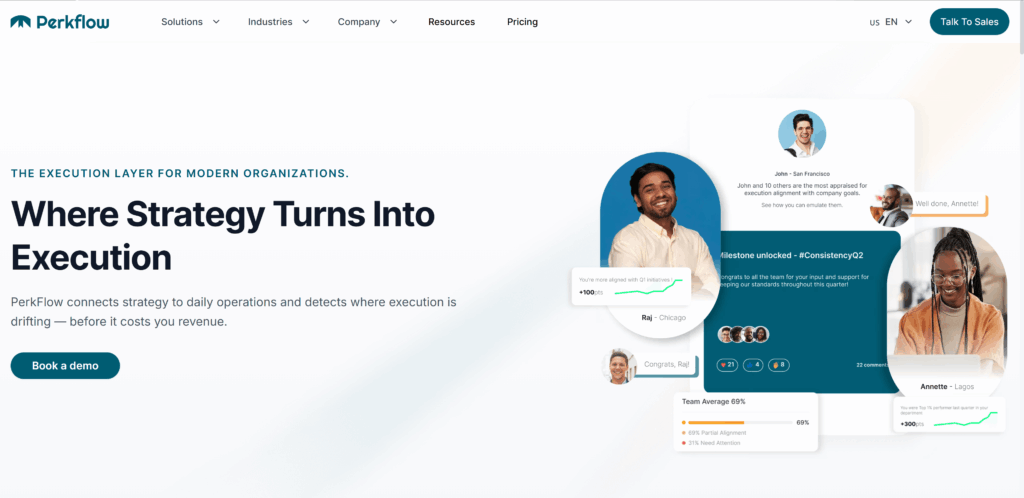
Perkflow is designed to help organizations turn incentives into a structured execution system, where recognition is directly tied to outcomes, milestones, and behaviors that matter.
Instead of treating incentives as isolated rewards, it helps teams build flexible, outcome-driven programs that scale without losing consistency or control.
A key strength is automation. Incentives can be triggered based on defined actions, performance signals, or milestones, reducing manual coordination while ensuring recognition happens at the right moment in the workflow. This helps close the gap between performance and reinforcement, a common source of execution drift in distributed teams.
The platform is built to support scale, from growing teams to more complex organizational structures, while maintaining alignment between incentive logic and business priorities.
PerkFlow is particularly effective for remote and hybrid teams that need a centralized system to ensure incentives are consistent, transparent, and tied to actual execution rather than visibility or manual tracking.
Best for: Outcome-driven incentive systems with automated execution loops
Ideal company size: SMBs to mid-market (scales with complexity)
Strengths: Automation, alignment between performance and rewards, scalable structure
Consideration: Advanced incentive logic may require initial setup to align with internal workflows
2. Bonusly — Best for Peer-to-Peer Incentives
Bonusly is widely known for its peer-to-peer recognition model, allowing employees to reward each other with points tied to company values. This approach helps create frequent, lightweight recognition moments that support engagement and culture.
While Bonusly excels at recognition-driven incentives, it is less focused on structured performance incentives. It works best for organizations that prioritize cultural reinforcement and everyday appreciation rather than complex incentive logic.
Bonusly integrates well with communication tools like Slack and Microsoft Teams, making recognition visible and social.
Best for: Peer-to-peer recognition incentives
Ideal company size: Small to mid-size teams
Strengths: Culture reinforcement, ease of use
Limitations: Less suitable for performance-based incentives
3. Nectar — Best for Small Teams and Simplicity
Nectar offers a straightforward approach to employee incentives and recognition, focusing on simplicity and affordability. The platform supports recognition, rewards, and milestone celebrations without heavy configuration.
For small teams or early-stage companies, Nectar provides enough structure to formalize incentives without overwhelming administrators. Its intuitive interface and low learning curve make it easy to adopt quickly.
However, larger organizations or those with complex incentive logic may find Nectar limiting as they scale.
Best for: Simple incentive programs
Ideal company size: Small businesses
Strengths: Ease of setup, affordability
Limitations: Limited advanced automation
4. Motivosity — Best for Culture-Led Incentive Programs
Motivosity focuses on building community, appreciation, and belonging through recognition-centric incentives. Its platform combines recognition, rewards, and social interaction into a single experience.
Motivosity is especially effective for organizations that want to strengthen workplace culture and employee connection. Incentives are often values-based rather than performance-driven, making the platform more suitable for engagement initiatives than strict output incentives.
The social feed-style interface encourages visibility and participation, reinforcing shared values.
Best for: Culture-first incentive strategies
Ideal company size: Mid-size organizations
Strengths: Engagement, community features
Limitations: Less emphasis on performance incentives
5. Awardco — Best for Enterprise-Scale Incentives
Awardco is built for large organizations with complex recognition and incentive needs. It offers extensive customization, enterprise-grade reporting, and global reward fulfillment.
The platform is well-suited for companies running large-scale programs across multiple regions. Awardco’s strength lies in its ability to handle volume and complexity, though this often comes with higher cost and longer implementation times.
Enterprise teams with dedicated HR resources will benefit most from Awardco’s capabilities.
Best for: Enterprise incentive programs
Ideal company size: Large organizations
Strengths: Scalability, global reach
Limitations: Less agile for smaller teams
6. Kudos — Best for Engagement-Focused Teams
Kudos combines recognition, incentives, and engagement analytics into a platform focused on strengthening employee relationships. It emphasizes appreciation, feedback, and values alignment.
Kudos works well for organizations that want to measure engagement alongside incentives. While it supports rewards, its primary strength lies in recognition and cultural insights rather than performance-based incentive automation.
The platform is particularly useful for HR teams seeking visibility into engagement trends.
Best for: Engagement and recognition incentives
Ideal company size: Mid-size teams
Strengths: Analytics, engagement focus
Limitations: Less performance-driven logic
7. Workhuman — Best for Formal Recognition Programs
Workhuman specializes in large-scale, formal recognition and service award programs. It is often used by established organizations with structured HR processes and long-term recognition strategies.
The platform emphasizes meaningful recognition moments and storytelling, making it effective for tenure-based and values-driven incentives. However, it may feel heavy for teams seeking agility or experimentation.
Workhuman is best suited for organizations with mature recognition frameworks.
Best for: Formal recognition incentives
Ideal company size: Enterprise
Strengths: Program depth, global recognition
Limitations: Less flexible for rapid changes
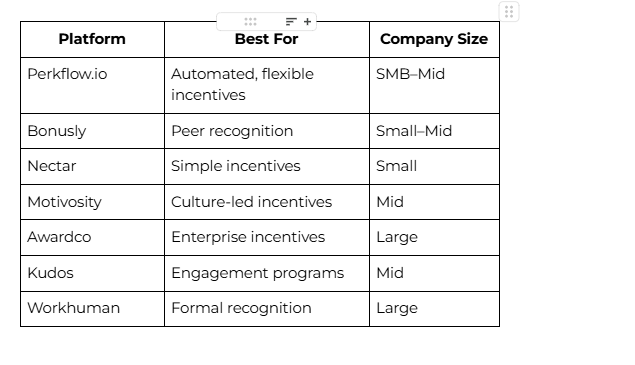
Comparison Overview
Employee Incentive Software FAQs
What is the best employee incentive software?
The best employee incentive software depends on your goals. Teams focused on automation and flexibility may prefer Perkflow.io, while culture-driven teams may benefit more from peer recognition platforms.
Is employee incentive software worth it?
Yes. Incentive software reduces administrative effort, improves consistency, and increases employee participation compared to manual programs.
Can incentive software support remote teams?
Most modern platforms support remote and hybrid teams by enabling digital delivery, global rewards, and asynchronous recognition.
What features should I look for?
Key features include incentive flexibility, automation, reporting, ease of use, and scalability.
Conclusion
Employee incentive software is no longer just about rewards, it’s part of how organizations shape execution.
When incentives are inconsistent or manually managed, recognition becomes fragmented and disconnected from actual outcomes. Over time, this weakens alignment between performance and reward.
The most effective systems are those that reinforce the behaviors and results that matter most to the business, consistently and at scale. That means the right platform depends on your structure: whether you prioritize automation, cultural reinforcement, simplicity, or enterprise-level control.
When aligned correctly, incentive software turns recognition into a continuous system of reinforcement, where performance, behavior, and outcomes stay connected.
Instead of ad-hoc rewards, you get a structured loop that strengthens both motivation and execution over time.
 Written by Ufan-Abasi Francis