How to Engage Remote Employees: A 2025 Role-Based Guide
 (1).jpeg)
In today’s global workforce, engaging employees is a business imperative. The real question many leaders face is: how do you maintain engagement when your team is fully remote?
Across Africa, the freelance and remote workforce grew at about 55% from 2020. Yet about 20% of these workers feel engaged at their jobs, 75% are open to new opportunities. This signals a deeper issue, people aren’t just leaving roles; they’re disconnecting from how work is structured and experienced.
A salesperson in Nairobi, a developer in Lagos, and a marketer in Accra all operate differently. They have different priorities, workflows, and expectations. Treating engagement as a one-size-fits-all approach often leads to gaps in alignment and inconsistent execution across roles.
This guide breaks down practical, role-based strategies, KPIs, and examples to help you build stronger connections, clarity, and consistency across your remote teams.
As you shape your approach, tools like PerkFlow can help you maintain visibility into how work is progressing across roles, so teams stay aligned and execution remains consistent, no matter where they are.
Why Role-Based Engagement is Important.
Never assume everyone enjoys being motivated the same way. About 31% of fully remote workers are engaged, quite a high number, right? 57% of them are watching out for the next new job. This automatically drops to 47% when engaged.
You need strategies beyond a one-size-fits-all checklist. One way to achieve this is to ask remote colleagues what they want, find out if they prefer quick chats, written praise, etc. You can do this through a survey form sent to all your employees.
Throughout this guide, keep in mind that meaningful recognition drives engagement: employees who get genuine praise are far more likely to stay loyal.
Well-managed remote policies can flip the statistics of engaged workers. The right support, beginning with your team, can make remote teams thrive, not just survive.
.jpeg)
Engaging Your Remote Sales Team
The sales team lives and breathes targets, customers, commissions, and deadlines. To keep them engaged, you should focus on clarity. Start setting clear KPIs: call count, qualified leads, conversation rates, or regional rates.
This gives them focus; they know exactly which metric they’re moving and can focus on what matters. Use your CRM dashboards to break big quotas into daily or weekly goals; this will show progress.
You can use gamification processes for your Gen Z sales employees. For instance, award badges for meetings or points for meeting step targets. You can also show a spotlight on the week’s performer and share a funny success story or client testimonial. Personalised welcome e-gift cards or vouchers are welcome too.
As you craft your strategy, consider tools like PerkFlow, which can automate recognition and rewards, turning every achievement into a motivator for your remote team.
Case Study: A fintech firm found their sales reps drifting after a quarter-end, which was indirectly telling the leaders ‘Something’s wrong. The manager introduced a weekly ‘Deal Highlight’ where reps briefly presented their sale (big or small) and lessons learned. Each presenter earned points. They tied individual KPIs to these rewards so targets felt tangible. Within two quarters, the team’s close rate jumped by 15%.
Tips: For the sales team, coach them on targets and institute a sales highlight reel each month. Track KPIs such as pipeline sizes, win rates, and customer renewal rates. Encourage peer-to-peer recognition as it builds team spirit.
Engaging Your Remote Tech Teams
Your remote tech teams need to be engaged. It’s not all about the bug fixes and tracking sprint velocity; it’s about understanding what keeps them going, doing the job. The following steps will help you engage with them:
1. Build Mentorship
Pair junior and senior developers for weekly check-ins or code reviews. It builds trust and belonging.
Practical step: Assign mentors for every new hire’s first 90 days. Track onboarding satisfaction and how quickly mentees start contributing independently.
Case Study: A Nairobi-based SaaS startup launched a remote mentorship rotation every sprint. Within two quarters, their code quality scores improved by 22%, and the number of pull-request reviews completed on time doubled.
2. Communicate Openly and Often
Clear communication prevents remote frustration. Encourage psychological safety so developers can speak up about roadblocks without fear.
Practical step: Introduce an “open thread” Slack policy. Any developer can post blockers, and teammates volunteer solutions. Reward those who regularly help others (through shout-outs or recognition points in PerkFlow)
Track: Response speed, collaborative tickets closed, and cross-team merges.
3. Recognise Creativity
Remote tech teams are naturally creative. Give developers space for innovation and be open towards it. Recognise creative contributions publicly, not just feature launches. This way, the team is in sync.
Practical step: Host a quarterly “Demo Day” to showcase new tools or ideas. Celebrate creative problem-solving, not just delivery.
Case Study: A fintech firm ran a 48-hour remote hackathon. One team built an internal API monitoring tool that is now used daily. Management awarded them “Innovation Tokens” redeemable for training courses. Engagement survey scores jumped 30%.
4. Fuel Self-Motivation with Autonomy
Developers thrive on trust. Let them own their time and projects with deadlines.
Try this: Automate milestone celebrations. When someone merges a big feature, PerkFlow can trigger instant recognition.
5. Encourage Learning and Growth
The majority of developers crave growth. Growth is an embodiment of a tech team. Offer learning hours or stipends for new certifications.
Practical step: Offer stipends or internal points for learning new tech stacks, writing documentation, or presenting tutorials. Publicly celebrate those who invest in their learning.
Case Study: A health-tech startup created a “Learning Leaderboard.” Every time a developer completed a course or shared a resource, they earned points and recognition credits. Within six months, upskilling participation rose 40%, and employee retention improved significantly.
Engaging Marketing & Support Teams
Keeping your marketing and support teams engaged takes more than check-ins. Here’s how :
1. Cultivate Collaboration and Inspiration
These professionals thrive on brainstorming, visual stimuli, and collective energy.
Practical steps:
- Host a monthly virtual “Idea Mash-Up” where creatives from different campaigns share draft concepts.
- Use surveys or quick polls asking the team which campaign theme they’d like to experiment with next and why.
- Recognise campaign successes publicly: share metrics like lead growth or social engagement, and call out the individuals and teams who pushed the creative.
KPIs to track:
- Content output (e.g., number of assets created),
- Campaign ROI (cost vs results),
- Brand engagement metrics (click-through rates, social shares, lead conversion).
Case Study: A digital agency created a “Campaign Hall of Fame.” Every month, colleagues voted on their favourite campaign or design; the winner got a curated gift box (using PerkFlow’s software) and a feature in the company newsletter. After six months, click-through/ conversion rates rose by 20 %, and their internal “I feel recognised” score jumped by ~30 points.
2. Recognise Excellence
Being a customer success or support professional can feel repetitive, to be honest. Most clients become impatient and sometimes, even abusive.
These roles can be high-stress, emotionally draining, and often invisible. Here’s how to engage
Practical steps:
- Share customer testimonials during team meetings, and highlight the agent involved in making that happen.
- Introduce peer-recognition slots: e.g., “Support MVP of the week” voted by the team.
- Offer micro-rewards: an extra break, an e-gift, or wellness credits when you hit high CSAT (Customer Satisfaction) or first-call resolution metrics.
KPIs to track: Customer Satisfaction Score, first-call resolution rate, ticket resolution time, escalation rate.
Case Study: A support team in a distributed setting introduced weekly shout-outs for “Outstanding Customer Care ” when agents resolved difficult customer interactions. After three months, their average CSAT rose from 82 % to 89 %, and staff turnover dropped by 15 %.
3. Enable Growth and Creative Freedom
Just like tech teams, marketing and support employees need space to be creative and express themselves. People stay engaged when they can learn, evolve, influence decisions, and see the impact of their work. Here is how to engage them:
Practical steps:
- Allocate a “Creative Sandbox Hour” each month for marketers to explore new formats, platforms, or tools (e.g., new video format, new support chatbot AI).
- For support roles, introduce peer-coaching: experienced agents rotate in to mentor newer ones, share best practices, and host mini-training.
- Integrate small rewards for skills growth: completing a marketing analytics course, mastering a new tool, or attending a conference. Recognition goes in your monthly all-hands and into your platform.
KPIs to track: Number of training hours completed, number of innovation proposals submitted, improvement in key role metrics (e.g., reduced response time for support, improved campaign creative scores).
Putting It All Together: Steps for You as a Manager
Whether you lead sales, tech, or any other remote team, a few management habits make a huge difference:
- Establish Trust and Autonomy: Remote employees perform best when you trust them to manage their schedules. Emphasise results over hours, and avoid micromanagement. Regularly remind your team that autonomy is a privilege tied to responsibility.
- Set Clear Goals and Measure Progress: Use Objectives and Key Results, KPIs suited to each role (pipeline for sales, sprint goals for devs, lead numbers for marketing). Tracking these transparently helps everyone know where they stand.
- Communicate Often, with Purpose: Don’t wait until deadlines are near; communicate them weeks ahead to keep everyone aligned. Balance structured check-ins (like daily standups and weekly demos) with spontaneous catch-ups.
- Deliver Frequent Feedback: Don’t wait for quarterly reviews. Give real-time feedback on wins and areas to grow. Platforms with analytics can help automate parts of this.
- Celebrate Milestones Publicly: Frequent feedback shouldn’t make you overlook the big wins. Whenever someone hits a milestone, finishes a major project, reaches a sales goal, or launches a new feature, celebrate it publicly.
- Be Inclusive: If in-person events happen, invite virtual attendance or equivalents. Share meeting notes across regions. Make sure remote folks aren’t left out of decisions or celebrations.
- Support Wellbeing: Particularly in remote settings, watch for burnout. Encourage breaks, share wellness resources, and respect personal time. Wellbeing fosters engagement.
Treating remote employees thoughtfully ensures they feel ‘just as valued as those in the office’.When employees feel seen, trusted, and celebrated no matter where they log in from, engagement stops being an HR strategy and becomes part of your culture.
Your Engagement Toolkit:
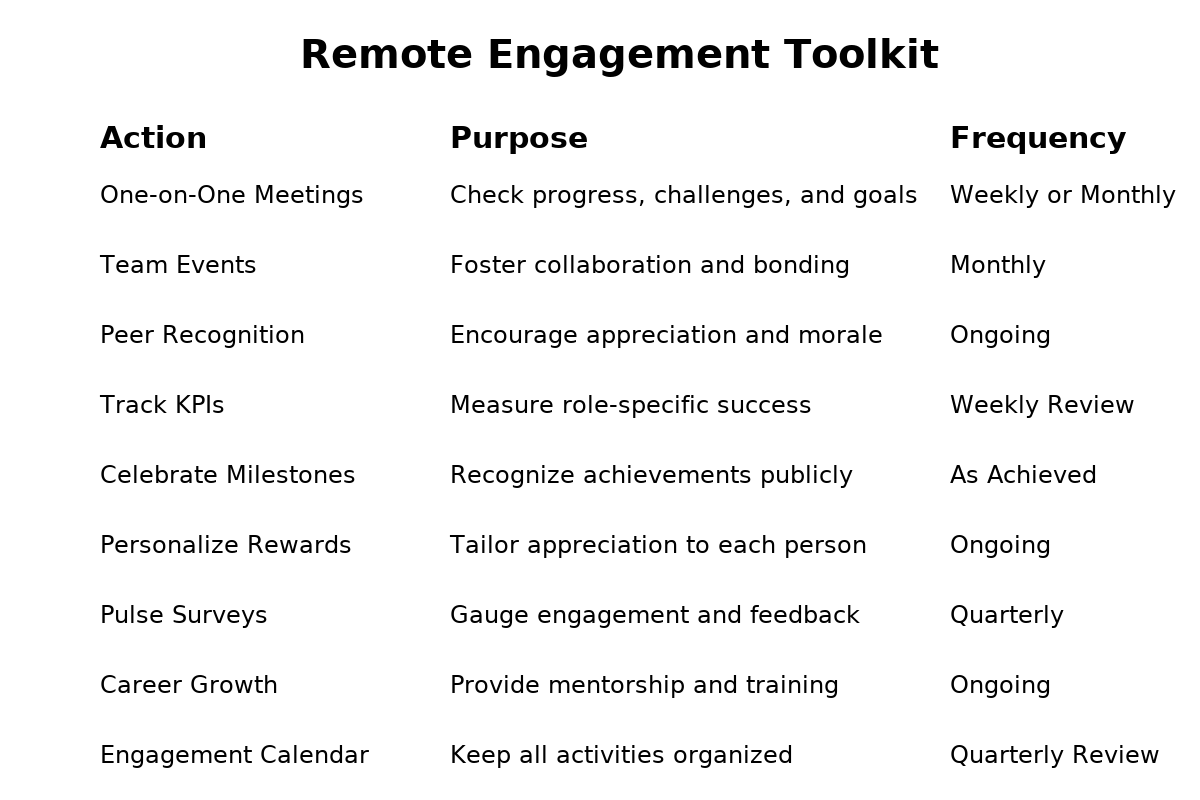
Role-Based Engagement Calendar Template: We’re preparing a downloadable calendar outlining weekly/monthly actions for sales, tech, and support teams. Use it to plan recognition moments, surveys, and team activities. Stay tuned on PerkFlow’s Resources page for this free tool.
By applying these role-based strategies and continuously refining them, you create an environment where teams stay connected, not just socially, but in how they work and deliver outcomes.
This shows that in remote environments, engagement is not just about energy or morale. It’s about clarity, coordination, and how consistently teams execute across different roles and locations. When that consistency is missing, performance doesn’t fail immediately; it gradually becomes uneven across teams.
PerkFlow helps leaders maintain that consistency by providing visibility into how work flows across roles, making it easier to keep teams aligned and execution on track as they scale.
 Written by Ufan-Abasi Francis