The Skills Blueprint: The Role of Skill Mapping in Marketing Teams(2026)

Skills gaps are already limiting business transformation. The World Economic Forum’s Future of Jobs Report 2025 found that 63% of surveyed employers considered them a major barrier.
A skills blueprint helps leaders determine whether their workforce can deliver the strategy ahead. It identifies the required skills, available capabilities, and gaps that could delay progress or create excessive dependence on a few individuals.
Skill mapping creates this blueprint by replacing job titles and assumptions with a clearer picture of what employees can do, their level of proficiency, and where development is needed.
This visibility supports better decisions about work allocation, employee development, recruitment and succession. It also helps organisations prepare for changing priorities before capability gaps begin to affect results.
How can this approach strengthen a marketing team? Read on.
What Is Skill Mapping and How Does It Affect Departmental Productivity?
Skill mapping shows managers who can perform specific tasks independently, who requires support, and where important skills are missing.
Skill mapping affects departmental productivity in several ways:
- Improves task allocation: Managers can assign work according to demonstrated ability. For example, a content manager with technical SEO expertise can lead search optimisation, while a strong interviewer can handle expert-led articles.
- Identifies skill gaps: The map reveals capabilities the department needs but does not currently possess, allowing leaders to respond through training, recruitment, or external support.
- Reduces delays and rework: Matching tasks with the right capabilities improves the quality of initial outputs and reduces repeated corrections.
- Exposes dependency risks: Managers can identify essential tasks that only one employee knows how to perform and arrange cross-training before absences or resignations disrupt operations.
- Makes training more relevant: Development programmes can focus on skills connected to actual responsibilities and upcoming projects.
- Supports collaboration between departments: Skill mapping shows when a team requires expertise from another function, such as analytical support from finance, customer information from sales, or technical assistance from IT.
- Strengthens workforce planning: Leaders gain clearer evidence for decisions about recruitment, promotions, succession and the capabilities required for future priorities.
- Creates clearer development opportunities: Employees can see the skills required for greater responsibility and work towards them through targeted assignments, coaching and training.
The Evolution of Marketing Team
Marketing teams once operated through relatively separate functions. In the 21st century, through digital technology, it has successfully merged many of these activities into one connected system.
Decisions are now greatly influenced by one another. The team must understand the customer, select the right channels, produce relevant content, manage technology, and interpret the data.
This combination has made marketing more measurable, but it has also increased the number and complexity of skills required.
Several developments have driven this change:
- Artificial intelligence: Employees must know how to use these tools, check their outputs, and manage privacy.
- Data-led decision-making: Marketing teams are expected to interpret customer and campaign data rather than rely mainly on intuition.
- Fragmented customer journeys: Customers move between search engines, social platforms, websites, email, physical locations and sales conversations. Teams need a clear understanding of how these touchpoints connect.
- Changing search behaviour: Traditional search engine optimisation now sits alongside social search, voice search and AI-generated answers. Marketing teams must understand search intent, authority, structured information and how audiences discover information across different platforms.
- Privacy and compliance requirements: Restrictions on tracking and the use of personal data have changed audience targeting and performance measurement. Marketers need a working knowledge of consent, data governance and responsible customer communication.
- Greater pressure to prove results: Teams therefore need commercial awareness, attribution knowledge and the ability to communicate performance clearly.
The Skills Modern Marketing Teams Need
The exact skills required depend on the organisation, market and strategy. Most teams now need a combination of the following:
How to Build a Skills Map for Your Marketing Team
A useful skills map should reflect the work the team performs, the standard expected, and the capabilities required for future priorities. Follow these practical steps:
1. Define the Purpose
Decide what the map should help you achieve. The purpose may be to prepare for a product launch, reduce agency dependence, improve revenue measurement, support regional expansion, or plan employee development. A clear purpose keeps the assessment focused.
2. Identify the Required Skills
List the activities needed to deliver the marketing strategy. These may include customer research, positioning, content creation, paid advertising, SEO, automation, analytics and campaign optimisation. Include only skills that influence current or upcoming work.
3. Group the Skills
Organise related skills into clear categories, such as:
- customer and market insight;
- strategy and commercial thinking;
- brand and content;
- channels and growth;
- data, technology and governance; and
- operating and interpersonal skills.
Grouping makes the map easier to complete, review and update.
4. Set Proficiency Levels
Use a simple scale with clear behavioural descriptions:
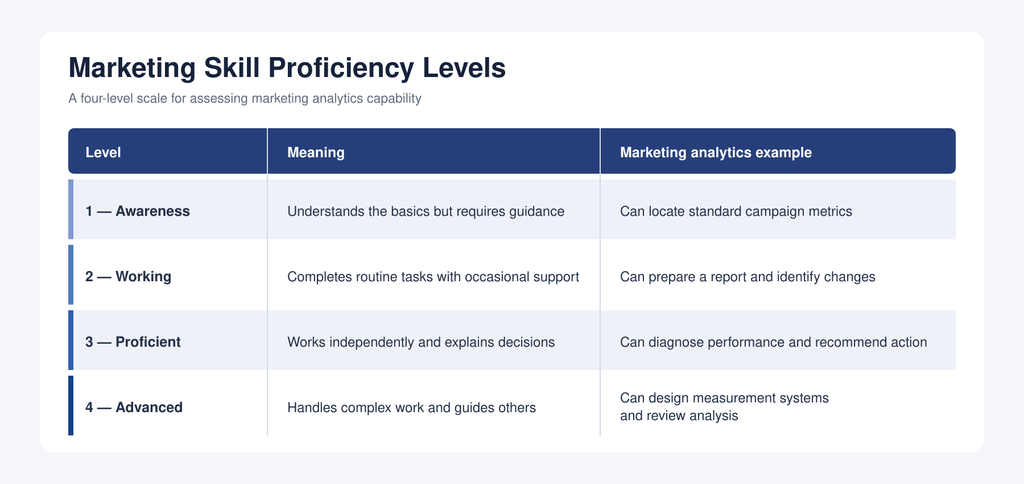
Define what each level looks like for every critical skill. Observable standards produce more consistent ratings than labels such as “good” or “expert.”
5. Assess Current Capability
Ask employees to complete a self-assessment, then compare their ratings with manager reviews and practical evidence. Evidence may include:
- campaign briefs;
- dashboards and reports;
- published content;
- experiment plans;
- automated workflows;
- campaign results; and
- feedback from relevant colleagues.
We recommend combining standardised ratings with practical evidence and input from more than one source.
6. Identify and Prioritise the Gaps
Compare each employee’s current level with the level required for the role or project. Prioritise gaps according to:
- importance to the strategy;
- size of the proficiency gap;
- risk to campaign delivery; and
- urgency of the skill.
A missing privacy skill may require immediate attention, while an advanced design capability needed next year can follow a longer development plan.
7. Select the Appropriate Response
Choose an action that matches the nature of each gap:
- Training: Build a skill several employees need.
- Coaching: Support an employee who is close to the required level.
- Paired work: Transfer knowledge from an expert to another team member.
- Reassignment: Move responsibility to someone with stronger capability.
- Recruitment: Bring in expertise that does not exist internally.
- External support: Use a contractor or agency for an urgent specialist need.
- Process improvement: Correct workflow or ownership problems that training cannot solve.
If skills are difficult to connect with daily responsibilities and results, PerkFlow connects strategy, role-specific execution, and performance signals so leaders can see whether available capabilities can be upskilled.
8. Create a Development Plan
Turn each priority gap into a practical action with:
- the skill to be developed;
- the assignment or learning activity;
- the person providing support;
- the expected evidence of improvement; and
- the reassessment date.
For example, a developing analyst could co-design the next campaign test with an experienced colleague and present the findings during the campaign review.
9. Review and Update the Map
Update the map after major campaigns, role changes, training programmes and strategy reviews. Quarterly updates are suitable for fast-changing areas such as AI, search, analytics and privacy. Regular review keeps the map aligned with the work the team must deliver next.
How Can Leaders Track Progress After Skill Mapping?
Counting completed profiles measures administration. Better indicators show whether the blueprint improves decisions and execution:
- percentage of critical skills with at least two independent practitioners;
- priority gaps closed by the agreed date;
- internal fill rate for marketing roles or project leads;
- time required to staff a campaign with verified capability;
- development actions completed through live work;
- reassessment based on new evidence;
- fewer delays or quality failures attributable to capability gaps; and
- improved campaign decisions, such as faster testing or clearer budget reallocation.
In a marketing team, outcomes arrive from multiple drivers. Track the decision chain instead, such as the map identified a measurement gap; a development assignment closed it; the team diagnosed waste earlier; budget moved to a better-performing segment.
Applying Skill Mapping to a Product-Launch Team
Imagine a seven-person B2B marketing team preparing to launch a product in the UK and Canada. The launch requires market research, positioning, paid advertising, marketing automation, sales support and revenue measurement.
The skills map identifies three important gaps:
- Limited market localisation capability: The team can analyse market trends, competitor activity and audience data. However, no one has experience adapting campaign messages, examples or channel choices for the UK and Canada. Regional specialists review the campaign, while message tests help the team determine what works in each market.
- Concentrated automation expertise: Only one employee can build and troubleshoot automated workflows. Their absence could delay lead capture, email sequences, and campaign reporting. A second employee works alongside the specialist, documents the process, and builds the next automated sequence under supervision.
- Insufficient commercial interpretation: Several employees can create dashboards and report campaign metrics. Only one can connect changes in leads, conversions, and pipeline value with revenue or budget decisions. During weekly reviews, each channel manager must now present one finding, the supporting evidence, and the recommended action.
These findings help the team assign responsibilities according to proven capability and create backup support for critical tasks.
Struggling to create honest capability conversations? Read our guide to building an ideal work environment.
The role of skill mapping in marketing teams
Skill mapping gives a marketing strategy its people blueprint. It shows which capabilities the plan depends on, who can apply them at the required level, where delivery relies too heavily on one person, and which gaps demand development, redeployment, hiring, or process change.
Its real role begins after the matrix is filled in. Leaders use the evidence to staff campaigns, create meaningful growth assignments, protect critical workflows, and connect capability with measurable outcomes. Marketing employees gain clearer expectations and more credible routes to progression.
PerkFlow is designed to connect strategy with role-specific execution, detect where delivery is drifting, and relate performance signals to outcomes. If your marketing skills map currently stops at assessment, book a PerkFlow demo to explore how capability and daily execution can sit in the same operating picture.
Frequently Asked Questions
What is the difference between skill mapping and a skills gap analysis?
Skill mapping records available and required capabilities across people, roles, or projects. A skills gap analysis compares current proficiency or coverage with the required state. The gap analysis is one use of the broader map.
How many skills should a marketing team include?
Use the smallest set that supports the decision. A focused project may need 10–20 skills. A full department taxonomy may contain more, grouped by domain and role. Excessive detail increases assessment time and makes maintenance harder.
How often should a marketing skills map be updated?
Review it when strategy, roles, or critical workflows change, and after major opportunities to demonstrate growth. Quarterly reviews suit fast-changing teams. Evidence should be updated close to the work rather than reconstructed at year-end.
Should employees rate themselves?
Yes, provided self-assessment is combined with clear behavioural definitions and other evidence. It can reveal hidden experience and development interests. Manager review, work samples and relevant stakeholder input improve calibration.
Can a small marketing team use a spreadsheet?
Yes. A spreadsheet can work well for a limited team and a focused purpose. Larger or distributed organisations need stronger version control, permissions, integrations and links between skill data, role expectations and execution signals.
 Written by Ufan-Abasi Francis